Showing posts with label action in facebook. Show all posts

Monday, April 8, 2013

11 Things You Need to Immediately Stop Doing on Facebook


11 Things You Need to Immediately Stop Doing on Facebook image dislike button stop sign 685x6851Are you getting tired of Facebook or some of the behavior of your friends on the site? Facebook is the most popular social network with over 1 billion active users. And with great popularity comes some shameful characters looking to tap into Facebook’s viral market to sell you their crappy products or scheme your money through affiliate links or worse.

So if you happen to find yourself doing any of the 11 following things, you should look to stop doing so immediately before all of your friends look to jump ship!

1. Tagging Random People in Photos

Please stop tagging people you barely know in photos that have nothing to do with them. It’s one thing when your buddy tags you in an unphotogenic pic, then sends it out to friends for some laughs, because, hey, at least it’s you. But the people I’m talking about upload photos and tag as many people as they can to try and gin up as many likes as possible. This is a classic move by spammers so be cautious of anyone who does this. I’ve had to call out several individuals over the years, even friends for their random tagging, and you should do the same in any suspect post. Sending a personal message to them to stop could work, too, but I feel like if some goofball wants to tag me in every one of his posts, he must be looking for my input so I give it to him publicly right then and there. Yes, revenge is a dish best served cold…

2. Cross-Posting From Twitter

Look, I understand you’re a little short on content and things to say. We all basically post the same stuff on Twitter, Facebook, Google+, etc. but at least have the decency to not automatically send your Twitter tweets to Facebook. For one, you’ll get much less engagement posting to Facebook via any third-party app let alone Twitter which basically disregards Facebook etiquette. If you do this, it’s a clear sign you’re not really engaged on Facebook or maybe just too lazy to post yourself, either way a fail.

11 Things You Need to Immediately Stop Doing on Facebook image FACEBOOK FAIL by Chibi Yuri

3. Liking Your Own Posts

So you’ve just posted the cutest cat or baby picture ever. That’s cool, I guess. But then you go ahead and like your photo too. Well, I know you already like the post, aren’t you the one who just shared the damn thing? Besides being annoyingly repetitive, the real reason people feel the need to do this is that the action of liking the post will again show up in the streaming news ticker, giving the post even more exposure (it’s potentially seen twice). These are typically the moves of self-proclaimed “social media gurus” or people who just feel insecure about their status posts.

4. New Page Invites

Look, I understand you need to create a page for your business, but please stop inviting me to your half-ass Facebook pages. Instead post interesting content to your own page, share it on your profile as well (so your friends see it), and if people find it interesting they will follow. It’s almost not your fault, as creating a page and inviting all your friends can be tempting, but most of your friends won’t like your page and maybe they won’t like you anymore either. And the ones who do like it would’ve probably found it anyways without your begging them to do so. So don’t do this…
11 Things You Need to Immediately Stop Doing on Facebook image message
11 Things You Need to Immediately Stop Doing on Facebook image what you really sound like on Facebook

5. App Requests

If you’re on Facebook all day playing Farmville, that should be embarrassing enough, and the last thing you should ever want to do is invite your friends and alert them to your nerdiness. And I can’t even explain to you the ill feeling I get when I receive a request to join Klout, for example, even though I’ve already registered, from one of my less intelligent friends.

6. Suggesting Friends

Please stop suggesting I friend somebody else. You playing match-maker is a little creepy and I might start to question why you and I are friends instead. And it’s actually worse than creepy because, you see, on Facebook expert spammers pair up and start suggesting up to 50 random friends for each other. By doing this, the people they suggest will get the notification (in their friend requests) and may mistakenly think the spammers requested the friendship. In reality, the spammers want you to commit the first step by adding them as friends (essentially tricking you to friend request them). Facebook penalizes people for requesting too many friends, but spammers who pair up and suggest friends for each other escape notice since they are not actually doing the requesting.

7. Adding People to Random Groups

This one’s a big pet peeve of mine. A classic text-book spam artist move, people will add you to random groups without your knowledge and all of a sudden you’re signed up for every single notification for each posts to the group. If this happens to you, make sure to leave the group or at least turn off the notifications within the group settings, as well as question the friendship with the culprit who added you. You don’t want to be the person known for doing this on Facebook, it’s a huge red flag.

8. Off-base and Mass Messages

Stop sending mass messages with dozens of people attached. You’ve seen these before, like “please like my page” or “vote for me in this ridiculous award I can’t win,” etc. People loathe being addressed in this style, and if you really have something to say at the very least personalize your message to each individual or, better yet, refrain altogether from sending out mass messages. After all, it’s straight out of the guide to spamming.

11 Things You Need to Immediately Stop Doing on Facebook image please vote
11 Things You Need to Immediately Stop Doing on Facebook image what really happens on Facebook

9. The Ridiculous Event Invite

I’m honored you want me to come to your poetry reading in Siberia, but I’m not quite sure I’ll be able to make it. When you send mass requests to a bunch of people you don’t really know, it makes you seem inconsiderate and pretty much paints you as a spammer.

10. Overdone Like Buttons

Somehow I’ve ventured over to your blog only to be greeted by an alarming pop-up Facebook “like” box baiting me to like your page. And then, when that goes away, I can barely even see your blog post because of the 100 “like” buttons strategically placed throughout your site.
11 Things You Need to Immediately Stop Doing on Facebook image too many like buttons

11. Poking People

Always sort of a joke, it might be time to finally retire this Facebook feature. Something just feels off every time you poke me. No matter how you cut it, there isn’t a single situation in which poking someone is acceptable.

11 Things You Need to Immediately Stop Doing on Facebook image poke me again i dare you

If you are one of the millions of people committing these crimes on a daily basis, please refrain from doing so at once! You know who you are. I promise you whatever you’re trying to sell or market will have a much better chance if you come up with some honest hard-working tactics like creating or curating interesting and relevant content as opposed to relative social media douchebaggery.

11 Things You Need to Immediately Stop Doing on Facebook image get more likes
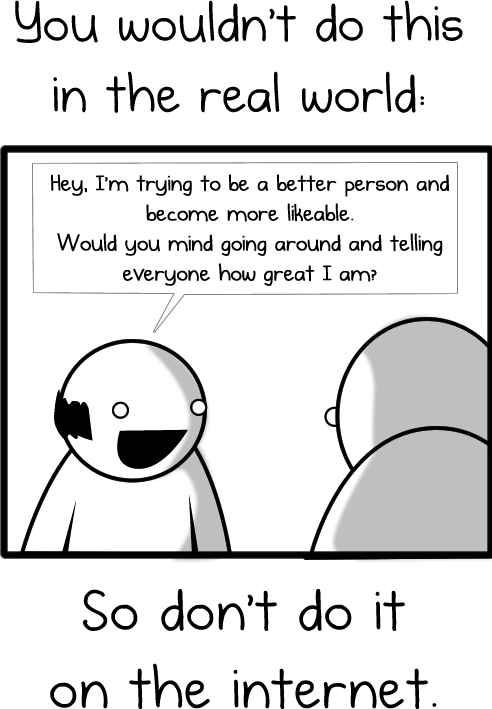
11 Things You Need to Immediately Stop Doing on Facebook image you wouldnt do this in the real world
11 Things You Need to Immediately Stop Doing on Facebook image create awesome things 685x1292


Thursday, June 7, 2012

Facebook to Marketers, It’s Time for a Click to Action


You Like me…you really Like me. Wait. Maybe you don’t really Like me after all. According to our Facebook engagement metrics, only 1% of you actually react when we post. So, to keep the numbers up, our team posts more often, asks questions, runs polls, curates content, introduces more and more contests, and asks for your help to submit your pics and videos as part of our “user-generated” content campaigns. 
We measure success by the Likes, comments, shares, the number of conversations, and reach. While the Likes are rising, we’re starting to recognize the pattern…I guess we never really defined why you should “Like” us beyond the initial click. We just took for granted that a Like equated to an opt-in.

This general scenario is more common than you may think. That’s all about to change however. Marketers must now rethink their Facebook strategy to define click paths and results. As Josh Constine recently reported, Facebook is now giving advertisers access to its API to improve post-click actions. In his post, Constine walks through a series of various scenarios for brands, developers and also local businesses to take advantage of the new Ads API. Here, we’ll talk more about how to start with strategy.

With the updated Ads API, advertisers must now think beyond the “Like.” Facebook’s Ads API will allow advertisers to present ads most likely to take specific post-click action such as content sharing, in-app purchases, Facebook Offers, among a list of other actions (see below). In the great pursuit of ROI, Facebook is also taking a lot of the guesswork out of ad campaign development and deployment to enhance desired performance. The new improvements give Facebook advertisers an unprecedented opportunity to connect with specific market segments based on intelligence to introduce more informed campaigns that trigger relevant clicks, conversions, and return.


What does “more informed” actually mean? Facebook is studying the behavior of its consumer population and as it does, it will provide deeper insights to brands seeking specific actions, such as those who are more likely to be a virtual good buyer, someone who actively shares content, who attends events, individuals who appreciate deals and offers. Over time, ads can be optimized for audiences based on this behavior as well. As such, brands must not only compete for attention and clicks, but also context and relevance based on behavior and preferences.

For brands and agencies, advertising based on keywords is no longer good enough. Now that you have a better shot at reaching the right people based on behavior, advertisers must now also become architects of experiences and outcomes.

Now advertisers can specifically optimize for…

1. People talking about this page
2. Page likes
3. Page post likes
4. Page post comments
5. Page post shares
6. @ mentions
7. Check-ins
8. Photo tags
9. Offers shared
10. Offers claimed
11. App installs
12. App used
13. Credit spend events (number of times someone uses credits in the app)
14. Credit spend amount (value of credits that were spent in the app)
15. Number of RSVPs


This is a click to action…

Designing campaigns now require brands and advertisers to think about the “click to action” they want to encourage. I refer to this as the A.R.T. of Engagement, where brands intentionally design campaigns to provoke relevant actions, reactions, and transactions. To take advantage of Facebook’s API, brands must now employ sophisticated advertising approaches that combine segment and contextual research, segment-specific strategies, app and channel development for each approach, UX, creative design, and real-time conversion metrics, review and optimization.


It’s more than Likes or forcing people through Like-gated apps or campaigns. Now it’s about performance and conversion science where…

1) Contextually relevant content appears in front of qualified and desirable audiences that…
2) Triggers a defined, useful action that…
3) Leads to optimized click paths that result in material content or activity, which then…
4) Motivates conversions to preferred outcomes and…
5) Delivers a more integrated, consistent, and efficient experience.

To engage more effectively through Facebook’s social advertising platform requires that all strategies and campaigns commence with a stated purpose. I believe that the best way to outline these scenarios is to begin with the end in mind and work backwards from there. By starting with the end in mind, the ability to research desired behavior and who to reach as a result becomes incredibly clear…and also inspiring.


The dimensions of engagement you’ll need to define are 1) what are you trying to accomplish, 2) what the experience looks/feels like, 3) what benefits you’ll offer and what they mean to the people you’re trying to reach, 4) the desirable outcomes you wish to measure, 5) How people feel as a result of the A.R.T. experiences you evoke, and 6) What the experience will look like in the most prominent channels of your connected customers.

This is why you’re now an architect of experiences and outcomes. It takes vision. It takes design. It takes measurement and optimization. The A.R.T. of Engagement is realized through a Social Experience Framework that starts with intentions and ends with resulting sentiment…not just the outcome.

There’s an old saying, “it’s not the gift that counts, it’s the thought behind it.” The same is true for social advertising, marketing and well, business overall. Intentions count for everything. Therefore your intentions must be realized as experiences where technology serves as the enabler to creatively and contextually engage to create experiences that meet or exceed expectations and ultimately inspire desirable outcomes.