Showing posts with label facebook posts. Show all posts

Thursday, September 11, 2014

Scheduling Facebook Posts for Businesses


Scheduling Facebook Posts for Businesses
Facebook's scheduling feature is undoubtedly a perfect solution if you don't spend your entire day online and if you have a rather packed agenda, but are still constantly aware of the crucial need to maintain a presence on social media.
This feature comes in handy if you are planning to be away from your desktop for a while, as it actually saves the trouble of going into Facebook once or even several times a day. It allows you to prepare your usual, eye-catching, thought inspiring content beforehand, lining it up according to your content calendar. All you have to do is type your post as you normally would, configure your settings and click "Schedule".  It's as easy as that.
Facebook's scheduling feature lets you choose the date and time of day for posting, as well as your target audience and a desired location.
 Read more
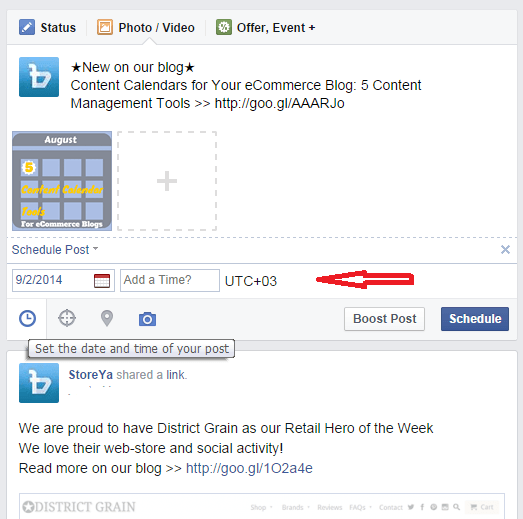
Facebook - set time and date
Having typed in your update, you can add a link, image or video to accompany the text. It is possible to include an image from the link source or to upload an image of your own. In case you wish to include an image from the source site linked to your post, you can use the arrows conveniently located in the top left corner, which allow you to browse and choose the appropriate image from that particular site.
Facebook share
Further customization is available with relation to the title and description of the update, which can be changed according to your need.


Facebook sharing customization
Naturally, you can also make use of Facebook targeting ability by clicking on the targeting icon and selecting the desired options. As for location, just click on the map pointer icon to define geographical boundaries for your post.
Facebook targeting sharing
Last but not least, add the year, month, day, hour, and minute you want to schedule your post for and once your satisfied, Click Schedule.
As we all know, it's only human to err – and Facebook posts are not excluded. Let's say you have made a mistake, and wish to edit your scheduled post. At times, you might also want to reschedule your post. Well, that's also easily done. All you have to do is access your activity log, locate the relevant scheduled post, hover over it and click on the little arrow located on the top right corner. From the drop-down menu, choose either Edit or Reschedule. Mind you – it's only possible to edit the main text of the post, not its image or link (in order to change those, you actually have to delete the post and then retype it and reschedule again).
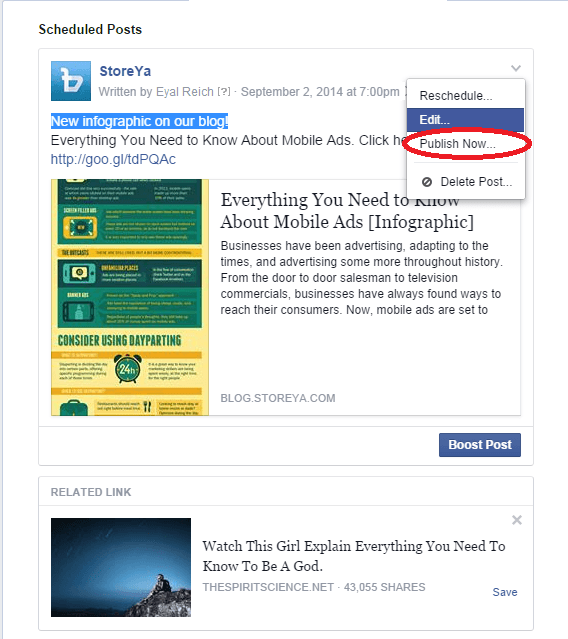
As we all know, social media environment is a dynamic one. Even the most meticulously structured plans can – and should - change to accommodate unforeseen developments. Facebook allows for great flexibility in this case, and lets you even change course and choose instant publication of a scheduled post. Once you locate your desired post on the activity log of your page, just click on the small arrow on the right and then select Publish Now.
Publish Facebook post
What about sharing your scheduled posts?
Well, Facebook will forever be Facebook – sharing is its lifeblood.
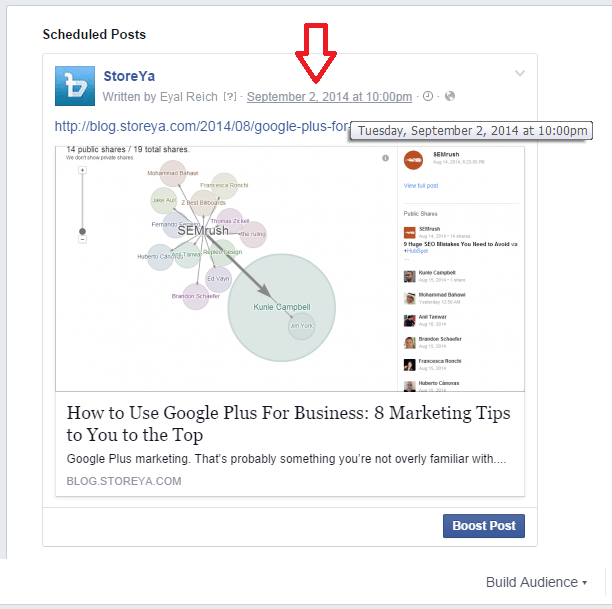
You can share your scheduled posts by locating your post on the activity log and clicking the timestamp at the top right of the post in order to open the post and copy the page url, ready for sharing.
Sharing a Facebook post
Scheduling posts is, in fact, Facebook made easier for busy business owners. You might even say it allows you to GET AHEAD OF TIME. In a dynamic, rapidly changing environment it is just one feature which creates a sense of certainty and allows for planning ahead. Naturally, you still have to closely monitor activity on your page and be prepared for a change of schedule should the need arise.

Friday, July 11, 2014

10 Ways to Overcome Facebook’s Organic Reach Problem

It's no secret that getting a decent percentage of organic reach on Facebook is no easy task. Then again, it hasn't been since at least 2012. Yet the interwebs are filled with folks who are still constantly screaming about this fact and bemoaning that no one sees their posts.
There are ways to overcome this problem. You don't have to give up and whine. When you look at your personal Facebook news feed, there are promotional posts from companies and sites that you want to see, right? I know there are in mine. They don't get there by accident, and yours won't get in others' feeds just because you decided to post something, either.
Success is about overcoming problems, not the absence of them. Choose to succeed with your social campaign, and be ready to do what it takes to make that happen. Here are 10 things that just might help you do that.
1. Get Over It
Before moving on and sharing what wisdom I've gleaned from here and yonder about this subject, first let me tell you to stop your whining. It doesn't help. Facebook has a reason for their organic reach policy. Imagine if there were no filter on your TV broadcast for what kind of or how many commercials could come through. You'd never see another program.
There are over 18 million business Pages on Facebook, and they all want your eyeballs seeing their posts. Without good filters, your news feed would become unbearable. Also don't forget that Facebook is a company that created a site that you use. Remember your place - nothing but a consumer. You either like their rules or you take your ball and go play somewhere else, but stop complaining about how they run the business that they own.
2. Get Out More
Facebook is not the only hangout in town. You should be making the rounds through the neighborhood - window shopping at Pinterest, catching up with the news on Twitter, geeking out at Google+, doing some business on LinkedIn, you get the idea. It's called a well-rounded social media marketing strategy.
I am definitely not recommending that you abandon Facebook; that would be insane from a business perspective. However, if you get more attention on Twitter or Pinterest, then I do recommend focusing more energy there. You can improve your Facebook reach, but you have to assess where your time and effort are best spent. A social media dashboard for cross-network posting is a must.
3. Do It the Old Fashioned Way
Remember back before social media when you had to make friends *gulp* in person? People are still people, even when they're online, so whatever might be annoying in a real conversation is going to be annoying in their news feed as well. People like interesting, not overbearing. People like nice and sweet, not abrasive and depressing. Use your common sense and turn your broadcasting into a conversation. Be interesting and engaged.
4. Flip Your Timing Around
Somebody had to do it, and that somebody turned out to be Jon Loomer. He decided to see what would happen if he started posting when his largest audience was offline instead of online, and the results were awesome. There are several possible explanations for this.
One is that with less people online, less people are posting, because they're all following whatever schedule their favorite social guru has told them will work - peak times. Posting off-peak increases your chances of reach in many cases, and may even extend your post's time at the top of the feed because of engagement during off-peak hours.
5. Understand Business Expenses
Facebook's explanation for lower organic reach and how to overcome it is always the same: buy ads and promoted posts. Guess what? They're right, to an extent. Facebook needs to make money just like any other business, or it will cease to be. Selling ads and promoted posts makes them money, and they like people that make them money. These are not a magic pill, but they certainly help and are, imho, a necessary expense of any business.
6. Bypass the Third Party
Create your own webspace that people can/will visit independent of the social networks. Use Facebook as a recruitment tool to guide people into your own community. These communities are treasure chests of information because they are a direct pipeline to your customers with no one acting as a middleman. You can also create your own mobile app for that direct contact.
7. Ask Interesting Questions
I don't know anyone who has the time or inclination to stop and answer ridiculous or rhetorical questions in their news feed. "IRS caught in new scandal. Do you think the IRS a corrupt institution?" Really? I'm expected to answer that? Why not pose something like "Shower survey: water or no water?"
Questions are one of the best ways to engage your audience, but you want to ask a question that will strike some chord in them and make them think, but not for too long. A really cerebral question can have the same end result as a stupid one. Make them think slightly and make it interesting, and see if you don't get more responses and shares. Check out the surveys that get shared left and right and take cues from them.
8. Go Back to Email
Did you know that email marketing is still the most effective form of digital marketing, hands-down? Yes, even in 2014 that is still the case. Build a solid email marketing campaign and then push them to like your Page in the email. Use your mailing list to seek them out on Facebook and engage them directly.
9. Emulate the Big Boys
Fortune 500 companies know what they're doing when it comes to almost anything in marketing. It's their lifeblood, and they take it seriously. Follow the pages of some of the big companies that are very successful on Facebook and see what they're doing. What kind of posts do they use? How often? Do they respond to comments? You might learn a thing or two.
10. Images, Images, Images
What gets shared? That's right, images get shared. Pictures, videos, infographics, repeat. If you aren't posting interesting, cute, or emotion-invoking images regularly, you don't understand the rules of the game. The more self-explanatory the picture is, the better. Not that text should be left out, but some pictures require no caption, and those are the ones that will spread the quickest.

Friday, December 20, 2013

The Secret to Amazing Facebook Posts

Amazing Facebook Posts

The best way to think about what you should post on your brand page is to think about what you enjoy reading or seeing on Facebook. For the most part, people love posts where they get coupons or discounts, but you can’t always be offering a giveaway. The rest of the time, what are the posts that get the most traction? They are the posts when the reader leaves the post feeling as though if they’ve just learned something truly useful and relevant. The secret? Offering value.

Why give away all of this useful information?

The posts on Facebook that offer the most value to their fans are the ones that have the most engaged audience.  It is common sense that if your audience in general is really happy with the content you are sending out, they are more likely to like, comment and share. When that happens, it’s also more likely that you’ll draw in new fans. Providing value also keeps your audience interested so that they don’t look for the dreaded unlike button. On top of that, research shows that if you, as a brand, are giving your audience valuable industry information, they are more likely to trust you, meaning that at the end of the day they will be more likely to buy from you, as a brand they trust.

What does it really mean to provide value to your audience?

So what does it really mean to be providing your audience with value? Essentially it is giving them information or access to something that they feel like they would pay for, but you’re giving it to them for free. Usually it’s information, which we all know is extremely valuable in today’s society, and by providing them with information that makes their lives easier, or teaches them something new, you are winning over the customer. In general when brands provide value they share real industry knowledge, or things they already share with current customers. The idea is to make your fans feel special, as though if they’ve been let into a secret, which is why it works best to share something with them that they will walk (or scroll) away from feeling as though if they’ve learned something really important and useful.

How do you do it properly?

Now you might be thinking that providing value sounds amazing (which it is), but how does it really get done? The truth is that it will be different for every industry, for every brand, however there are some general best practices that will give you an idea of what to start out with.
  • Tips and Tricks: Letting your fans in on great little known tricks is a great way to grow your fan base.  One great example is travel agents who share their top travel tips. This is easy to do year round because usually you can adapt your advice for each season. For a travel agent especially it can be traveling in the summer, and over the holidays. Another great example is a local farmer that shares great recipes (using their ingredients) with their fans. They can do fall recipes, winter recipes, etc.
  • Using Images to Explain Ideas: For example the fashion boutique who share images for how to wear multiple pieces, demonstrate how to take only 8 basic pieces and turn them into 25 different outfits, or how to dress for the particular season. Giving your audience a visual of the information you are trying to convey will always catch their attention a little bit more and make your post a little more memorable.
  • Blog Posts: If the information you want to give them is just too long for a Facebook post or Tweet, make it an entire blog post! Once you have the blog post up it’s great content to share across your social media sites.
  • Bonus tip: Repurpose blog posts into short Tweets and Facebook posts, for example if you gave 8 tips for making the best apple pie at home, Tweet one of the eight tips every now and again, and link back to the original blog post.
If you’re not sure yet what kind of content will be most valuable to your fans, communicate with your current or prospective client base. Find out what kind of information they would love to hear from you so that you can do your best to send it their way!

A Couple More Examples

Just to make sure you really understand, here are a few more examples for how to make sure you are really giving your audience the best and thinking outside the self-promotion box.
A music store could stream free playlists on their website and link to it through their Facebook page. They could offer a playlist of the month and sell the albums on the playlist at a discount for only that month and take down the playlist once the month is over.
If you own a restaurant you can talk about food, recipes and dining out. If you sell fitness clothes talk about workouts for at home or outdoors workouts, the type of clothes to wear at yoga class versus cycling class.
If you operate a bakery, and definitely don’t want to share recipes, you can also talk about parties. Most people going into a bakery might be buying cakes for birthdays and special occasions. Address party tricks, different ways to set up the cake, fun ways to cut the cake, different cake traditions around the world, and so on in your content! The possibilities are really endless when you open up your social media to that larger subject and give your audience the content they really want to see.
The important thing to remember is that on social media you don’t have to (and shouldn’t) be talking about yourself and your services all the time. It’s social media because you are supposed to socialize with others! The best way to draw your fans to you is by giving them something they would love to read, see or hear. The idea is that you can talk about the larger subject that your business or product addresses.  Once your brand truly encompasses this idea the content will get much more exciting and the fans will definitely take notice!

Thursday, August 29, 2013

11+ Facebook Posts to TurboCharge Engagement with Your Fans

Facebook Engagement

You know your brand should have a Facebook strategy. Or even if creating a strategy seems beyond your reach, you know you should share something on Facebook every day. After all, with more than 1 billion users, it’s the world’s most popular social network.
You can’t afford to miss out.
But where should you start? What should you post?
It’s easy to go wrong.
Equally, it’s easy to go right. In this post, we share 11 different types of Facebook post you can start using right now. If you just do one post a day, Monday-Friday, you’ll have enough content for over 2 weeks before you need to start over. And each post type comes with thousands of possibilities.
Before we begin, a word of warning.
The biggest mistake – and this is something we see all the time – is making your Facebook updates all about you and your brand. Sure it’s sometimes okay to share what you’re up to. But the vast majority of the time, you should focus on your audience and aim to enrich their lives.
It’s a delicate balancing act. On the one hand, everything you post should reflect your brand values, and subtly build a relationship between your brand and your audience. On the other hand, your main aim is to keep your audience engaged, which is pretty much impossible if all you do is post what’s been happening at the office today.
Pull your fans into a conversation. Give them a pick-me-up to inspire their day. Talk about things they’re interested in. Post photos they’ll want to share.
Now you’re in the sharing, audience-focused frame of mind, it’s time we got this show on the road.
Best Days to Post on Facebook

Infographic courtesy of LinchpinSEO.

1. The Question

We put questions first because they’re so important. Even though other types of posts will get more likes and shares, questions are how you really engage with your audience and get to know them.
Questions spark conversation. Questions help you discover what matters to your Facebook fans, and the more you know what they care about, the better questions you can ask.
Research shows posts containing questions receive twice as many comments as posts without questions.
Questions work best when they’re simple and easy to answer. Where possible, provide choices for potential answers. If your questions can be answered in just a handful of words, you’ll get much higher engagement. Examples of simple questions include:
  • What’s your favorite … ?
  • Agree or disagree? [Controversial statement here]
  • What do you think about … ?
  • Would you rather … or … ?
  • What do you love about … ?
  • What are you reading right now?
  • What do you think about our product/service?

2. The Fill The Blank

Just like questions, fill the blank posts are perfect for starting conversations with your fans. Fill the blank posts promote engagement because your fans only need to write one word. The lower commitment level means you can generate big responses.
Fill in the blank posts typically receive nine times as many comments compared to other post, yet less than 1% of brands use them.
Examples of fill the blank posts include:
  • Fill the blank: The one place I plan to visit in my lifetime is …
  • Fill the blank: My favorite fruit to use in a smoothie is …
  • Fill the blank: Before I do anything else in the morning, I …
As with all posts, keep the Fill the Blanks you ask relevant to your industry and brand values.

3. The Icebreaker

Had a recent influx of new Likes on your page? Write a post welcoming your new fans to the team. Show them the ropes – tell them about your most popular product, or the most-read blog post on your website.
Ask them to introduce themselves and say how they discovered your brand, and what they like about you. Not only will you gather up valuable insights into what’s working in your marketing, you’ll also show you’re open to conversation, and you’ll get your fans into the habit of engaging.
This also matters in terms of how Facebook calculates the Edgerank of your posts. When someone first likes your page, your posts are more likely to show up in their news feed. If you get people to engage early, your posts will continue appearing in their news feed. Miss out on early engagement, and you’ll drop off the radar.

4. The Milestone

Milestones are a relatively recent addition to the Facebook timeline, and their value lies in helping you tell your brand’s story.
You can add milestones for the present or the past. Some milestones you might like to add to your page are:
  • The founding of your business.
  • When you got your first customer.
  • Times you changed your brand name or logo.
  • Moving to a new location.
  • Opening a new store.
  • Launching a new blog or website.
For inspiration on how you could tell your brand’s story through milestones, take a look at Coca Cola’s Timeline, and scroll down as far as you dare. It goes all the way back to 1886. We especially like the 1916 post about bottle design.

5. The Image

They say social networks are becoming more and more image based (actually, we say that too). And it’s true, research by HubSpot found photos generate 53% more likes than average.
That’s not to say you should flood your followers with images. Use them sparingly, because they’re powerful. Also, photos aren’t king. Status only updates receive 94% higher than average engagement. So where possible, keep things simple.

6. The Wise Quote

We love sharing inspiration on Social Caffeine. If you take a nosy at our Facebook page you’ll see we share two or three quotes every week, usually embedded in an image.
As well as attracting likes and shares, quotes are ideal for promoting your content, such as your blog or ebook. For example, you can quote:
  • Snippets from your most popular blog post
  • Sections from your latest ebook
  • Highlights from a report or whitepaper
As long as it’s relevant and engaging to your customer base, go ahead and get it out there!

7. The Announcement

Remember what we said in the opening? Make your posts about your audience, not about you.
We’ve come across some pretty dire Facebook updates in our time. Brands who post press releases in full expecting them to be read. Brands who share their latest meeting with a supplier. Brands who believe that appointing a new accountant needs to be shared with the world.
Maybe this stuff is relevant to shareholders. Maybe. But your Facebook followers aren’t there for a shareholder briefing.
To your followers on Facebook, all this stuff is meaningless. Facebook is not the place for corporate jargon or for kissing the posterior of people you want to impress.
That said, sometimes you’ll have exciting news that is relevant to your fans. Maybe you’re launching a new product, or setting up shop in a new location, or you’ve rejigged your menu.
This kind of stuff – things your fans will want to know – is totally okay to share. Go ahead and announce it to the world!

8. The Curated Link

Links aren’t great for engagement. In fact, they’re the worst thing you can do if you want to attract likes, comments or shares. Why’s that? Because when someone clicks a link, they’re taken away from Facebook. It takes a lot of effort to go back to Facebook and like a link to an article you enjoyed.
That said, we share a ton of curated content on the Social Caffeine Facebook page. Why do we do this?
  • Curating content shows you know what you’re talking about. The magic of quality content rubs off on you when you share it.
  • Curated content shows your audience you can meet their needs. If they enjoy (or need) the links you share, then it’s fair for them to assume they’ll enjoy (or need) your product or service, too.
  • Curating content is fun and educational. By searching for content to share, you learn a lot and have a blast in the process.
  • Curating content is relatively easy. It’s certainly quicker than writing it all yourself, and if it’s already out there, why not use it?

9. The Promotion

Research shows one of the main reasons people Like brands on Facebook is to receive discounts and promotions.
When you’re offering a discount, make the math as simple as possible. Rather than offering 10% off, offer a $5 discount. Typically “$ off” promotions receive 17% more engagement compared to “% off” promotions.

10.The “Like if You Agree”

There’s a love/hate thing going on here. Some Facebook users think it’s patronizing to be asked to like stuff (“Duh! We know how it works…”). Marketers, on the other hand, know a call to action can make a massive difference.
Getting likes from fans boosts your edgerank, and many Facebook users are lurkers who’ll only like something if they’re asked to do so.
Used sparingly, the “Like if you agree” post adds a little dynamite to your Facebook engagement, giving your posts the boost they need to reach a wider audience.

11. The Video

Videos, like links, have a surprisingly low level of engagement. Even so, YouTube has let slip that 500 years worth of video are watched on Facebook every day. And that doesn’t include the videos hosted directly on Facebook.
While typical engagement is low, videos give you the best chance of going viral.
When posting videos to Facebook, it’s better to upload straight to Facebook, rather than using YouTube. Understandably, Facebook gives more clout to videos shared on its own platform by nudging them up with an Edgerank boost.
Making original videos takes time, commitment and creativity, but it can pay big dividends if you hit the viral jackpot.

Bonus: The Hashtag

Hashtags are the new kid on the block at Facebook. While not specifically a type of post, if they take-off on Facebook like they have on Twitter, then including hashtags in your updates will become a surefire way to boost engagement.
Start using hashtags today. You’ve got nothing to lose by slotting them into your status updates, and being an early adopter can help you stand out from the crowd.
mycleveragency Social Media Perfect Post Infographic


Infographic courtesy of mycleveragency.