Showing posts with label New York Times. Show all posts

Sunday, July 13, 2014

Twitter Engagement Study: Top Apps, Content Sources & Profiles Among Search Marketers

The search marketing community is one that can be defined by the topics we write about and share with our colleagues. In its latest report, “How Search Marketers Engage on Twitter,” social insights company Leadtail looked at 521 U.S. search marketers (SEMs) on Twitter to discover what topics they talked about, which content they consumed and shared, and what publications and people were the most influential in the Twittersphere.
When it comes to sharing content on Twitter, SEMs preferred their desktop tools over mobile. According to the data, 80 percent used the Twitter.com website to share. 
social-sharing-types
SEM industry sites and content were the most shared amongst search marketers at 58 percent, while mainstream media was shared 29 percent of the time. 
types-content-shared
The most-shared mainstream media included content from Forbes, The New York Times and The Wall Street Journal, to name a few.
most-shared-mainstream-pubs
Most popular industry sources for content included Search Engine Land, Search Engine Watch and Marketing Land.
most-shared-industry-pubs
(via)

Wednesday, February 6, 2013

The Power of Valentine’s Emotion in Content Marketing


Evoke emotions from readers with content. Provide entertaining or heartfelt content that triggers readers to feel emotional engagement between themselves, your business, and the holiday.
Many marketers believe that evoking emotion through content marketing is essential to make posts go viral. It could be a picture of a mother hugging her baby, or a story of a soldier reuniting with his love for the first time in a year.
In a study regarding the shareability of articles at the New York Times, it was discovered that:
  • Awe was the second most viral type of content to be shared
  • Conversational posts receive twice as many comments on average
  • Posts filled with emotion are typically shared more
According to a study conducted by the University of Indiana, there are 6 primary emotions that humans have that you can tap into with your content.
  1. Surprise
  2. Joy
  3. Sadness
  4. Fear
  5. Anger
  6. Disgust
Although especially for Valentine’s Day, it is easier to stick to the first two; Surprise and Joy. Anything unexpected or positive in an inspirational or humourous manner will lead people to share your content.
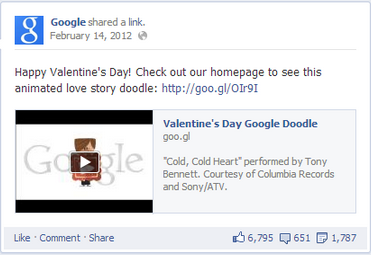
Google’s Valentine’s Day post last year was a touching video that only lasted a minute long, yet created emotional reactions from the viewers. It featured a famous song by Tony Bennett that pulled at the heart strings.

Still have no idea how to relate your business to Valentine’s Day?
Why not post anti-Valentine’s Day content? Get in touch with people’s dislike or disgust of the holiday. You may find that some people will react negatively to this, but this is a common risk with social media.

Topics that allow you to share an alike interest or opinion with your fans and followers bring on engaging conversations.

Include an image or list of things you hate about Valentine’s Day. Engage your audience by posing a question such as, “What do you hate about Valentine’s Day?” Get the entrants to discuss it on your Facebook page.

What do you dislike most about Valentine’s Day? ↓

 (via)

Sunday, August 26, 2012

SEO Practices You Will Want to Avoid


There are a number of sketchy ways for you to optimize your website, each one that can cause your site to be penalized by the search engines. Practice any one of these with consistency and you may find your site invisible in Google, controller of approximately 70 percent of all search engine traffic. Naughty or “black hat” SEO practices should be avoided; we name seven egregious examples here.
1. Link Commerce. Search engines, especially Google, value websites based on a number of reputation factors including the sites that link to it. The quantity and quality of links can raise a website’s visibility tremendously.
Links pass PageRank, a Google method for ranking web pages. Links that pass PageRank are in violation of Google’s Webmaster Guidelines and can adversely effect that site’s ranking in the search results.
Google does permit you to sell links as part of your advertising strategy, but not for helping others game their PageRank position. To avoid being penalized by Google, you’ll want to add a “no follow” attribute to the link tag. Google states that you can also redirect “…the links to an intermediate pages that is blocked from search engines with a robots.txt file.
2. Link Exchange. The difference between link commerce and link exchange seems, on the surface, to be small. With the former, money is exchanged between two parties; with the latter, no money changes hands, just links.
The problem with link exchanges is that they’re typically done to impart PageRank artificially. Google calls these practices “link schemes” and may penalize your site accordingly. Links that Google deems as intending to manipulate PageRank, including links to bad neighborhoods or known spam sites and are used in excess, can cause your site to take a hit. Avoid reciprocal linking that appears unnaturally such as a list of blogs that you follow in your sidebar.
3. Barter Deals. Some webmasters create complex linking strategies that they think won’t catch the attention of search engines. These strategies are sometimes embraced by small time web managers and, surprisingly, have been used by large companies too.
Let’s take the example of J.C. Penney. In February 2011, the New York Times exposed a practice where the giant retailer was finishing atop of the search engine results pages in searches for words such as “furniture” and “home decor.” They also finished atop for specific keywords and phrases such as “grommet top curtains” and “Samsonite carry on luggage,” the latter beating even Samsonite.com. Turns out that Penney’s search engine company was buying links to push the retailer up to the top of the SERPs. The Times article prompted Google to intervene, effectively burying numerous SERP results for the retailer. Overstock.com employed a similar strategy, but bartered links in exchange for discounts on its site.
4. Doorway Pages. Creating pages to take users from one page to another is a doorway page. Such pages are largely frowned upon, but not always for reasons that you might imagine.
Doorway pages are allowed, but they must contain useful and original content. Moreover, those pages should be filled with “rich information” and contain the usual relevant keywords that is related to your content. Be mindful, however, that pages that contain scraped or automatic generated material will be penalized. Employing sneaky redirects on these pages will have you courting Google’s wrath.
5. Page Swapping. You get a page to naturally rank high in the SERPs, but then you get the idea to change the content completely, perhaps placing a sales or affiliate page in its place.
Certainly, you can and should update your page content when the information changes or more relevant news can be shared. But, those changes must be related to the content it got ranked for and never four new content that is unrelated.
6. Mirrored Content. The search engines prize unique, interesting and well written content. This makes for pages that can rank quite well and raise the visibility of your website.
Sites that make use of mirrored content, material that is found elsewhere on the Internet, can be devalued. Those great articles you found on an article directory may appear on several other websites, effectively diminishing the value of your pages. Avoid spun articles too — material that has been changed slightly to appear unique. Search engine sophistication can pick up subtle variations of text too.
7. Keyword Stuffing. The more you use keywords, the better…right? Wrong. Keywords should appear naturally within your articles or content — a good rule of thumb is one for every 100 words of text written.
It also goes without saying that you avoid placing your keywords at the bottom of your page and either changing the color of the text to make it look invisible or using a smaller font. You’ll get Google-slapped for employing a black hat SEO practice and will have to beg the search engines to reinstate your site once you remedy the problem.

Sound SEO

We just went over seven black hat SEO practices, including some of the more obvious ones that are used less often today. White hat SEO practices include guest blogging, using keywords in your headers, making use of meta tags, employing natural link baiting, and making use of relevant press releases. Each of these practices are considered legitimate and can help your website thrive online when embraced in accordance with webmaster guidelines.


Monday, June 25, 2012

So What if Facebook is a Fad?


If The New York Times is asking, it must be serious. Is Facebook really just a fad?
The NYT is just the latest to jump on the bandwagon of wondering whether Facebook's recent troubles spell an end to the share era. A couple recent surveys found Facebook user engagement was down (34 percent of users in one survey were spending less time on the site, which some labeled "boring" or "not relevant") and a sizeable number of Americans (46 percent) in another survey thought the company would fade away. And, you know, the stock isn't doing so hot.
I can't seem to get too excited about these surveys. Predictions about the future of technology are famously wrong. President Hayes is reported to have told Alexander Graham Bell, when first seeing a telephone: "That's an amazing invention, but who would ever want to use one of them?" And a reviewer from the good old New York Times suggested the television didn't have staying power after seeing a demonstration in 1939: "The problem with television is that people must sit and keep their eyes glued on a screen; the average American family hasn't time for it."
Photo Courtesy of BirgerKing
So there's that. But in a larger sense, it seems like an obvious question. Of course Facebook is a fad. I have no idea whether Facebook will still be popular when my seven-year-old is old enough for an account (and actually, I hope it's not), but I'd be downright shocked if my grand kids are using it.
And it's not surprising that user engagement waxes and wanes. A recentstudy from the Atlantic suggests new parents may rely more on Facebook during the turbulent newborn days. Conversely, people who may have been huge Facebook users when they were younger have started families or jobs and may be less interested in what their friends are up to. Facebook doesn't make social interaction magically wonderful all the time. Hanging out with friends can be "boring" and "not relevant" on live chat as easily as in real life.
But Facebook, as well as other social media channels, has forever changed the fabric of online interaction. It's brought my grandma online, because that's where the latest great-grand kid updates are posted. It's made email seem like a clunky tool for keeping in touch. It's allowed the quirky to become mainstream. And, as Raafi Rivero pointed out, it enables interactions that would not have been possible in a world without thriving online communities.
It doesn't take a business degree to see that Facebook is facing some tough times right now. The recent IPO stirred up a lot of bad PR, even if the future of the stock is still up in the air. Facebook's ability to make money on advertising has taken some blows, with GM pulling ads and big advertisersquestioning whether Facebook is hungry for their dollars. Maybe the company, which has smart leaders, will figure out a way to make money off its massive user base. Or maybe Facebook's lasting legacy will be as a social experiment rather than a big business.
But if Facebook does fade away, you can bet there will be something ready to take its place. The success of established social media brands such as Facebook and Twitter, as well as the rapid rise of newcomers like Pinterest, mean that there are tons of social media startups looking to make their mark. Gamification looks to be breaking through big time, and a crop of new crowdfunding sites allows entrepreneurial Internet users to turn "likes" into dollars. Whether Facebook reinvents itself or The Next Big Thing takes over, I suspect we're only seeing the tip of the iceberg when it comes to the social Web.

(via)