Showing posts with label PeerIndex. Show all posts

Monday, April 29, 2013

5 Advanced Social Media Metrics for 2013


As any metrics-obsessed marketer can attest, a campaign is only as successful as you can prove it to be. But beyond flaunting your progress for the benefit of hovering clients and executives, social media reporting can lead to valuable insights to inform not just your social campaigns, but your marketing strategy as a whole.
Read on to learn five advanced tracking techniques that may be missing from your current reporting strategy and how they can serve to improve your overall campaign.

1. Define and Track Conversions

Although I always remind clients that social media is a way to connect with users first and score conversions second, it’s never long into our dialog before the conversation reroutes to the question decision-makers love to ask: “What’s the bottom line?”
So, let’s begin with the basics: What’s a conversion, and how do you track it?
A conversion occurs anytime a consumer or client does what you want them to do. This could be buying an item from your site, visiting your brick-and-mortar store, joining your mailing list, watching the video on your homepage, or calling your 800 number, among other possibilities.
Some conversions are easier to track than others; while it’s pretty easy to set up eCommerce and Goal Tracking on Google Analytics, finagling a brick-and-mortar customer into remembering where they heard about your deal on widgets is another story.
Some ideas to step up your tracking game:
A. Conversion Paths
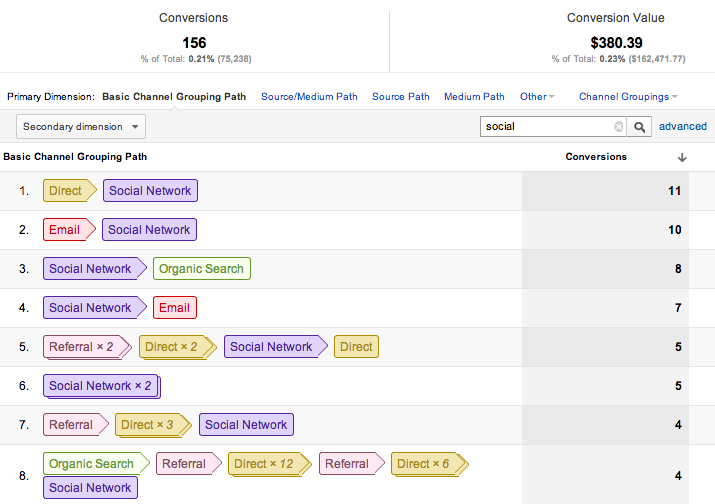
Google Analytics’ Top Conversion Paths feature (found under Conversions > Multi-Channel Funnels) makes it easy to see contributing sources to your tracked conversions, not the just the direct source they visited right before converting. This is a great way to appreciate the value of a strategy like social media, which can be an important component to the conversion process.
In the screenshot below, I searched “social” on analytics to bring all of the social networking results to the top of the list. Now, I can see that my website has received 156 conversions with social media components in the last month for a total profit of $380.
Analytics

B. Outside the Box
Just because a conversion cannot be monitored on Google Analytics does not mean it cannot be monitored at all. For brick-and-mortar scenarios, consider providing a printable coupon that can be tracked in the store, or simply imploring shoppers to say “Facebook” at checkout for a small discount. You can also try marketing for one location at a time so your other locations can serve as control cases.

2. Segment Your Ad Data

When my company was just getting started with Facebook advertising, the barrage of data was understandably overwhelming and we tended to cling to certain critical stats, which are indications of success: Cost Per Fan (CPF), Cost Per Click (CPC), Click-Through Rate (CTR), etc. However, each campaign has its own distinct challenges, variables, and success rates, and lumping them together into net data points can lead to some deceiving results.
For example, assume you have a CPF of $.35 for your current ads. This is a pretty good rate, but when you look further, you realize that your ads targeting women in their twenties rake in a CPF of $.05, while your campaign for middle-aged men has a CPF for $.70. In this scenario, it would make sense to put more of your budget to the $.05 CPF ads (assuming you’re OK with an influx of chicks) while continuing to experiment with your $.70 CPF ads on a smaller budget.
You can segment your ads by many different factors, including age, gender, location, interest, product line, and landing page/app.

3. Harness Your Email Service Provider (ESP)

One of my favorite things to do with a social media campaign is to collect email addresses through a promoted giveaway. It works like this:
Step 1: Pick a prize at least $200 in value of interest to your target demographic.
Step 2: Create targeted ads that promote said giveaway.
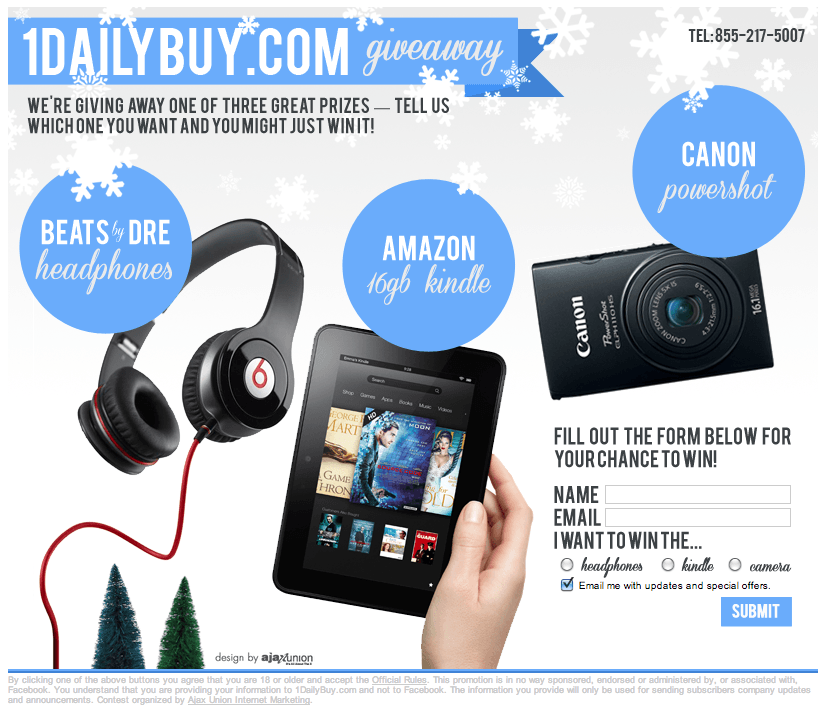
Step 3: Ads lead users to a custom application (example pictured) requesting their name and email. The app should include a checkbox where users can indicate that they would like to sign up for email marketing updates.*
Daily Buy
At the end of your giveaway, which I recommend you run for about a month, you should have a collection of targeted email addresses for your marketing pleasure. If you’re new to email marketing, try out MailChimp, which is free for up to 2,000 email addresses.
Why email? Email marketing continues to have the highest ROI in online marketing, because when a user opts in to your email list, they are giving you a major vote of confidence. Store your social media campaigns as distinct lists on your ESP to compare your return from various demographics, while benefiting from additional data points such as open rates and clicks.
This same method can be used on social networks beyond Facebook as well, as long as you are leading users to an email opt-in entry form.
*This last part is important! It’s better to have a smaller list of prospects interested in your email blasts than a sprawling array of people who only wanted to win a free whatever.

4. Leverage Advanced Tracking Tools

Share of Voice (SOV) and Influence are two of the newest — and most important — metrics in social media.
A. Share of Voice
SOV calculates your company’s slice of your industry’s social media pie. This metric concerns brand mentions, so it incorporates content authored by you and your competitors, along with content by the general public. To calculate your SOV, take the quotient of your brand’s total mentions over the total mentions of all the brands in your industry.
Browsing your general SOV across social channels can be a good way to get a sense how you’re stacking up against competitor groups. For even more telling results, partition your SOV by network to review missed opportunities on a site-by-site basis. As an example, you might have a 20% SOV in general, but only 5% on YouTube, which would mean you need to step up your video game.
To monitor your SOV, consider paid solutions such as Radian6, Spiral16, or Scoutlabs, or get started with SocialMention, which is free.
B. Influence
Influence is essentially the PageRank of the social media world, and it serves as an important statistic, especially in the context of the bottom line. Measured for both users and brands, Influence quantifies the extent to which an entity’s shared content can affect the behavior of other users.
There are a couple major players in the Influence world, each of which measures things a bit differently. Compare yourself and your brand with competitors on Kred, Klout, and PeerIndex to see what insights can be gained.
Other potential metrics in the Influence vein include community sentiment (are your fans and followers happy? sad? neutral?), community size, and level of engagement.

5. Invest in PPC Remarketing

Remarketing — or as I like to call it, legal stalking — is one of Google AdWords’ coolest innovations to date, but a lot of marketers forget to incorporate it into their social media strategies. In case you are unfamiliar, remarketing is a way to reach out to users that have previously visited your website using visual ads on the Google Display Network. This is accomplished by embedding Google’s Remarketing tag on the pages of your site; you can have one general tag for your whole site, or correlate specific ads with specific pages — so people who visit your digital camera page can see more ads about digital cameras, for example, rather than ads cover all of your products.
Since Facebook applications are just iFrames (i.e., external pages coded and designed by you), these can also be used to house Remarketing code, allowing you to turn visitors to your Facebook page into visitors to your site.
Google AdWords offers a host of its own metrics; you can try out different Remarketing lists with different apps and demographics, and compare your results and conversions to shape your strategy moving forward.

Monday, February 4, 2013

7 Steps To Manage Your E-Reputation


1. WHAT PEOPLE ARE SAYING ABOUT YOUR BRAND

There are numerous free tools allowing you to discover what people are saying about you and your brand on social media, forums or blogs. One of my favorites is Social Mention, which lists mentions about your brand but also provides information about sentiment, i.e. positive, negative, neutral. I also like the fact we can see keywords used, users who mention the brand, on which platform, and so on.
Social Mention
Screen shot of a search for “Hard Rock Hotel San Diego” on Social Mention
Other free tools worth your while are Topsy, as well as Google services such as Google News andGoogle Alerts. If you use a social media dashboard such as Hootsuite, SproutSocial, SocialBro orTweetDeck, they are also useful to monitor conversations about a brand, assuming you set up streams and filters relevant to your company and industry.

2. INVEST IN KEYWORDS & SEO

If you did your due diligence in step one, you ought to know what are the keywords people and customers use in order to find you, your brand or your competitors. A strong content marketing strategy stems from knowing the right triggers in your target audience’s mind, in order for you to fulfill their needs and wants with pertinent information. Assuming these keywords and information are aligned with your product and services, you must ensure content is formulated with this in mind across all communication channels, offline and online, including web sites, newsletters, blog, social media, press releases, etc. Search engine optimization (SEO) thus becomes more accurate and relevant, and will segue into more efficient search engine marketing (SEM).
From a marketing stand point, you can access this kind of information as well as your competitors’ to better understand which keywords are generating web traffic and on which keywords you may want to invest in AdWords campaigns. The best place to start is by looking at your own web site analytics, i.e. with Google Analytics, or with sites such as compete.com or alexa.com. In this example, you can see keywords that would be relevant for the Westin San Francisco:
Westin San Francisco keywords on Alexa
Keywords for the Westin San Francisco on alexa.com
Staying sharp on this front ensures you know who, when and what is being searched regarding your property or destination. This is also an important component of managing your online reputation.

3. IDENTIFY AND ENGAGE INFLUENCERS

Frederic Gonzalo on Klout
Imagine Lady Gaga or some celebrity mentioning your product or service, raving about it to its millions of followers. How cool would that be, right? But turn it around, and what happens if a known influencer rips your property or destination apart on his or her blog, mentioning the horrible service received and vowing never to return? While these extreme situations don’t happen that often, there are people raving or trashing your brand on a daily basis on the blogosphere and social media. You can’t monitor it all, but you certainly want to address those who have the biggest potential for ripple effects and multiplication.

The field of “influence marketing” is still nascent, yet there are three important players that claim to evaluate your influence online: Klout, Kred and PeerIndex. There are various opinions on how precise these influence scores really are, and to what extent one should give any of these indicators credit, but whatever tool you use, you do need to unravel who are the people you want to have on your side as brand loyalists to spread the good word. Once you know who are the folks that you really should connect with in your town, your industry or your field of expertise, then you can engage with them. Not promote or push your promotions down their throat. Engage.
This can happen through various Twitter chats or perhaps even on Facebook, but the two best places in my opinion are via Linkedin Groups and Google+ communities. Like-minded people share questions, answers, comments and opinions according to groups and communities, which represents a great opportunity to meet folks that can later on turn into friends, clients and brand advocates.

4. STRATEGIC ONGOING MONITORING

What you did in Step 1, you basically need to continue doing on an ongoing basis. This is akin to the rinse & repeat formula! In order to be more strategic in your approach, you may want to consider more sophisticated tools, such as Radian6, Sysomos, Beehive and other premium platforms that monitor not only conversations online but also sentiment, in much more detailed ways than free tools can allow. Doing this can help identifying shifts in popular sentiment about your brand, allowing you to be proactive with the situation at hand rather than reacting once it’s too late.
Being strategic also means identifying platforms that are essential in your brand reputation management. While Facebook is the king of social media right now, it may not be where most of your efforts should go if it’s not where your clients are or where they choose to engage with you. If you are a hotel, you will want to monitor and respond to comments made on Tripadvisor, Bookings.com or Google Places. As a restaurant owner, you would keep a close eye on Yelp, OpenTable or FoodSpotting.

5. CREATE A MULTI-PLATFORM CONTENT CALENDAR

Having an editorial calendar is one of the golden rules in content marketing, yet one common mistake made by organizations is to deal with tactics in isolation, regardless of what may be happening in other departments of the organization or with external parties. A multi-platform content calendar thus should stem from business objectives on a yearly basis, and highlight strategies in key departments (Sales, Marketing, Communications, Public Affairs, Human Resources, Customer Service) and tactics employed, offline and online.
Having this long-term, holistic view helps prevent situations such as Qantas airlines’ #QantasLuxury campaign fail in 2011. We are all too familiar with the “left hand not knowing what the right hand is doing” syndrom, but having tools like a multi-platform content calendar in place, along with regular cross-functional team meetings, can address potential public mishaps like McDonald’s #McDStories or Wendy’s #HeresTheBeef. 

6. INVOLVE EMPLOYEES AND BRAND EVANGELISTS

Brand evangelists
Having a thriving community online, whether it’s on Facebook, Twitter or Linkedin is great in many ways: it can help foster new ideas for product and service development, help with cross-promotion, retention and loyalty. Brands who encourage employees to engage on social media, such as Zappos or Nordstrom, can also benefit from an extended reach and more diverse voice that helps “humanize” the brand and have more authentic conversations. Of course, this assumes you already have a clear social media policy in place or an organizational culture where social and transparency are ingrained with corporate genetics.

Having employees and brand evangelists you can count on is a distinct advantage if and when a crisis arises, as they can and will advocate in your favor, so you have an “army” of social collaborators to restate the facts, as a situation may require, on various platforms where your marketing or communications team alone could hardly outreach with equivalent efficiency.

7. EXPECT THE UNEXPECTED

Last but not least: be prepared! While it is technically impossible to expect the unexpected, you can at least prepare for a crisis situation. If you work in a ski resort, what happens if a gondola or chairlift falls, killing many people on the spot? These are hypothetical situations that resorts should already be prepared for, but now that news break on Twitter, with real-time photos taken via Instagram, how would you deal with it?
A crisis management strategy needs to be in place, along with running drills for hypothetical situations. Who’s in command? Who is the spokesperson? What content goes on social platforms, who is entitled to communicate, which channels are prioritized, etc. These questions can and should be identified before a situation occurs, so that when the unexpected happens, you will know what to do.

(via)

Saturday, April 7, 2012

Social Media Trend Predictions For 2012

At the end of each and every year, we tend to look back and try to identify the most significant events that recently emerged so we can predict trends that will continue to grow well into the New Year and reshape social media.
2011 was a big year for social media and web technology. We saw trends like Rebecca Black getting more views on her "Friday" video at a faster pace compared to Justin Bieber, a huge shift in Internet services moving to the cloud, and the launch of the now very popular Google+ social network.
There's a lot to take into account and nobody could ever accurately predict what will happen in the future, but it's interesting to try anyway. Here are a few social media predictions we are expecting to see in 2012.
A bigger shift in social media toward branding, customer service and B2B marketing.
It has become increasingly more important for businesses to invest in social media for promoting their products or services and for communicating with customers. In time, businesses won't be able to afford NOT to use social media for marketing.
In 2012, more businesses should be paying closer attention to blog posting, content marketing and interacting with customers through networks like Facebook and Twitter.
Of course, while social media has always traditionally been embraced by the B2C (business-to-consumer) sector, it's also expected that B2B (business-to-business) branding through social media will experience significant growth 2012.
Relevant and measurable social media influence.
Social media influence has been a touchy subject in 2011, especially after Klout changed their scoring algorithm. Some people argue that you simply can't measure a person's true influence with a number, while others say that social influence measurement will continue to play a large role in an individual or company's social media activity.
It may be long after 2012 when we see a real, significant impact by the measurement of social influence given that social influence is in its "embryo" stage. Still, sites like Klout, Kred and PeerIndex should continue to grow in popularity and complexity throughout the New Year.
Social television converging with traditional television.
Don't be surprised to see traditional TV and the internet converge and reshape the way we choose how, when and why we watch television in 2012.
It sounds like Apple will be launching a new product or service involving television in the near future, and we already love using Internet services like Hulu, Netflix, YouTube and others to watch our favorite shows on demand.
In 2012, it looks like all of our media devices including our television sets, computers, laptops, tablets, and smartphones could come together to offer us more social and sharable television experiences that we can enjoy whenever we want.
Social media affecting search results.
Search engines like Google are continuously perfecting their algorithms, and they'd be out of their minds to ignore the shift toward social media relevance. Google recently made some tweaks to their search algorithm that now returns more timely and recently published content in search results.
For websites and company's that have blogs updated frequently, the integration of social media into search engine results is important. Moreover, search results are getting a lot more personal and customized to individual preferences, especially now with the integration of Google+.
Pages that have previously been shared by your network on Facebook, Twitter or Google+ rank higher in your own search results. However, For somebody else's search results for the same keyword may look comparably different because their network of friends shares different content.
Expect to see your search results move even more toward social relevance in 2012.
Facebook taking sharing to a whole new level.
At the time of this writing, Facebook has not yet fully rolled out its new Timeline profile to all users and people still have to press the "like" button manually to share content with their friends on Facebook.
Eventually, Facebook sharing will become automatic. When you're reading a blog post on your favorite blog or watching a YouTube video from one of your favorite creators, it will be shared automatically via open graph sharing.
To sum it up, Facebook is way ahead of all the other social networks out there and will likely become the web's default sharing platform in the coming years. Get ready to see those huge changes (including automatic sharing) start to roll out in 2012.