As any metrics-obsessed marketer can attest, a campaign is only as successful as you can prove it to be. But beyond flaunting your progress for the benefit of hovering clients and executives, social media reporting can lead to valuable insights to inform not just your social campaigns, but your marketing strategy as a whole.
Read on to learn five advanced tracking techniques that may be missing from your current reporting strategy and how they can serve to improve your overall campaign.
1. Define and Track Conversions
Although I always remind clients that social media is a way to connect with users first and score conversions second, it’s never long into our dialog before the conversation reroutes to the question decision-makers love to ask: “What’s the bottom line?”
So, let’s begin with the basics: What’s a conversion, and how do you track it?
A conversion occurs anytime a consumer or client does what you want them to do. This could be buying an item from your site, visiting your brick-and-mortar store, joining your mailing list, watching the video on your homepage, or calling your 800 number, among other possibilities.
Some conversions are easier to track than others; while it’s pretty easy to set up eCommerce and Goal Tracking on Google Analytics, finagling a brick-and-mortar customer into remembering where they heard about your deal on widgets is another story.
Some ideas to step up your tracking game:
A. Conversion Paths
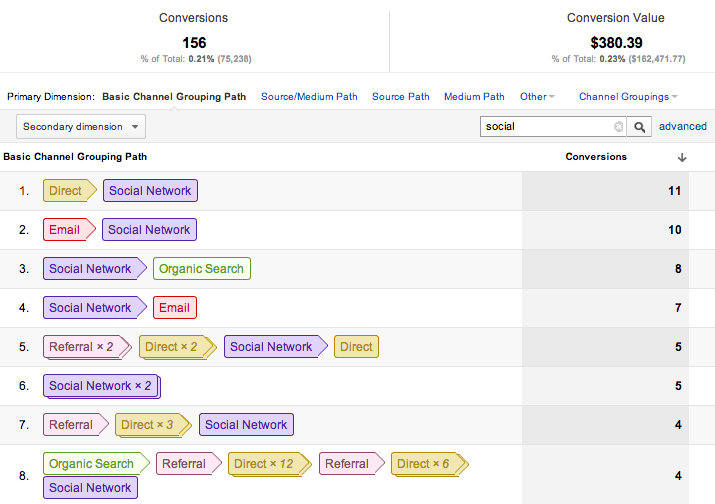
Google Analytics’ Top Conversion Paths feature (found under Conversions > Multi-Channel Funnels) makes it easy to see contributing sources to your tracked conversions, not the just the direct source they visited right before converting. This is a great way to appreciate the value of a strategy like social media, which can be an important component to the conversion process.
In the screenshot below, I searched “social” on analytics to bring all of the social networking results to the top of the list. Now, I can see that my website has received 156 conversions with social media components in the last month for a total profit of $380.
B. Outside the Box
Just because a conversion cannot be monitored on Google Analytics does not mean it cannot be monitored at all. For brick-and-mortar scenarios, consider providing a printable coupon that can be tracked in the store, or simply imploring shoppers to say “Facebook” at checkout for a small discount. You can also try marketing for one location at a time so your other locations can serve as control cases.
2. Segment Your Ad Data
When my company was just getting started with Facebook advertising, the barrage of data was understandably overwhelming and we tended to cling to certain critical stats, which are indications of success: Cost Per Fan (CPF), Cost Per Click (CPC), Click-Through Rate (CTR), etc. However, each campaign has its own distinct challenges, variables, and success rates, and lumping them together into net data points can lead to some deceiving results.
For example, assume you have a CPF of $.35 for your current ads. This is a pretty good rate, but when you look further, you realize that your ads targeting women in their twenties rake in a CPF of $.05, while your campaign for middle-aged men has a CPF for $.70. In this scenario, it would make sense to put more of your budget to the $.05 CPF ads (assuming you’re OK with an influx of chicks) while continuing to experiment with your $.70 CPF ads on a smaller budget.
You can segment your ads by many different factors, including age, gender, location, interest, product line, and landing page/app.
3. Harness Your Email Service Provider (ESP)
One of my favorite things to do with a social media campaign is to collect email addresses through a promoted giveaway. It works like this:
Step 1: Pick a prize at least $200 in value of interest to your target demographic.
Step 2: Create targeted ads that promote said giveaway.
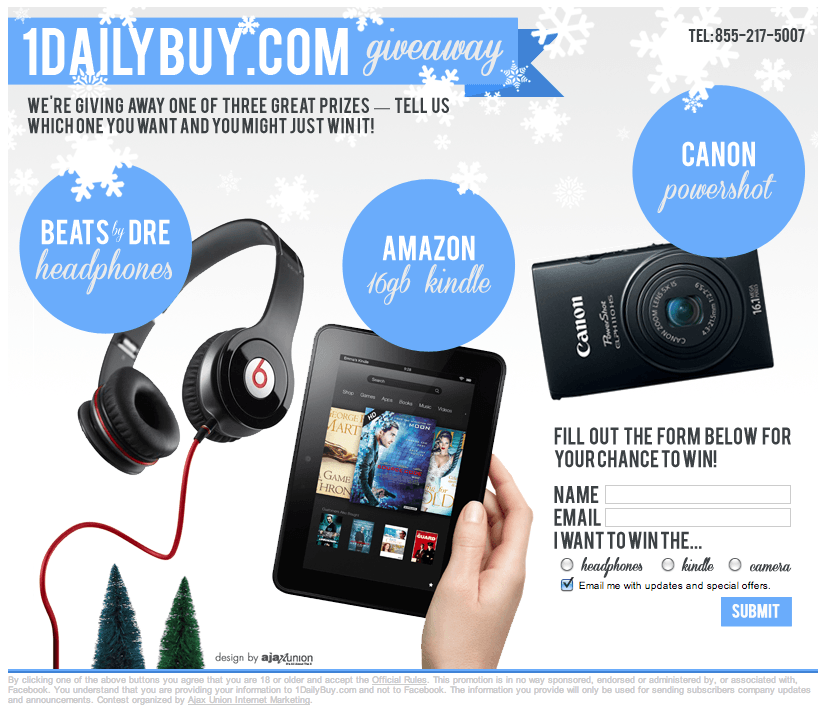
Step 3: Ads lead users to a custom application (example pictured) requesting their name and email. The app should include a checkbox where users can indicate that they would like to sign up for email marketing updates.*
At the end of your giveaway, which I recommend you run for about a month, you should have a collection of targeted email addresses for your marketing pleasure. If you’re new to email marketing, try out MailChimp, which is free for up to 2,000 email addresses.
Why email? Email marketing continues to have the highest ROI in online marketing, because when a user opts in to your email list, they are giving you a major vote of confidence. Store your social media campaigns as distinct lists on your ESP to compare your return from various demographics, while benefiting from additional data points such as open rates and clicks.
This same method can be used on social networks beyond Facebook as well, as long as you are leading users to an email opt-in entry form.
*This last part is important! It’s better to have a smaller list of prospects interested in your email blasts than a sprawling array of people who only wanted to win a free whatever.
4. Leverage Advanced Tracking Tools
Share of Voice (SOV) and Influence are two of the newest — and most important — metrics in social media.
A. Share of Voice
SOV calculates your company’s slice of your industry’s social media pie. This metric concerns brand mentions, so it incorporates content authored by you and your competitors, along with content by the general public. To calculate your SOV, take the quotient of your brand’s total mentions over the total mentions of all the brands in your industry.
Browsing your general SOV across social channels can be a good way to get a sense how you’re stacking up against competitor groups. For even more telling results, partition your SOV by network to review missed opportunities on a site-by-site basis. As an example, you might have a 20% SOV in general, but only 5% on YouTube, which would mean you need to step up your video game.
To monitor your SOV, consider paid solutions such as Radian6, Spiral16, or Scoutlabs, or get started with SocialMention, which is free.
B. Influence
Influence is essentially the PageRank of the social media world, and it serves as an important statistic, especially in the context of the bottom line. Measured for both users and brands, Influence quantifies the extent to which an entity’s shared content can affect the behavior of other users.
There are a couple major players in the Influence world, each of which measures things a bit differently. Compare yourself and your brand with competitors on Kred, Klout, and PeerIndex to see what insights can be gained.
Other potential metrics in the Influence vein include community sentiment (are your fans and followers happy? sad? neutral?), community size, and level of engagement.
5. Invest in PPC Remarketing
Remarketing — or as I like to call it, legal stalking — is one of Google AdWords’ coolest innovations to date, but a lot of marketers forget to incorporate it into their social media strategies. In case you are unfamiliar, remarketing is a way to reach out to users that have previously visited your website using visual ads on the Google Display Network. This is accomplished by embedding Google’s Remarketing tag on the pages of your site; you can have one general tag for your whole site, or correlate specific ads with specific pages — so people who visit your digital camera page can see more ads about digital cameras, for example, rather than ads cover all of your products.
Since Facebook applications are just iFrames (i.e., external pages coded and designed by you), these can also be used to house Remarketing code, allowing you to turn visitors to your Facebook page into visitors to your site.
Google AdWords offers a host of its own metrics; you can try out different Remarketing lists with different apps and demographics, and compare your results and conversions to shape your strategy moving forward.

