Showing posts with label ecommerce. Show all posts

Tuesday, September 9, 2014

Which social media network drives the most ecommerce conversions. . .?

If you had to guess (and you do) which social media network drives the most ecommerce conversions, I’d guess that you’d say Facebook. Unless, of course, you’ve already seen this chart from the new “Myth-Busting Social Media Advertising” from AOL Platforms and Convertro.
The answer is (insert drumroll). . . .
YouTube!
But don’t hand over the rose bouquet just yet.
Convertro Social Media Funnel
YouTube may have come out on top but it still didn’t make a very good showing with only 14%. Facebook came in second along with the much maligned Google+. How about that?

Now take a look at those long, blue lines. This represents the middle of the shopping funnel. People already have some idea of what they want but they haven’t settled on a particular brand, store or model. This is the. . . I know I want a new TV but should I get a flat screen, HD, big, small, smart, curved, Samsung or Sony, Walmart, Best Buy or somewhere else . . . portion of the game.
Clearly, people are turning to social media for recommendations, answers to questions and a definitive answer to “which is best?”
If you go by size of the line, it would appear that Twitter is king but that’s not really true. All that means is that people spend more time searching for answers than anything else on Twitter. With only a 4% conversion rate and almost non-existent “first” and “only” rate, it’s clearly not the top choice for consumers.
The chart changes drastically when you look only at paid advertising. Twitter becomes the only touchpoint in 30% of the cases and conversions triple.
Coverto Social Conversions Paid
What’s truly fascinating is what’s happening on the left side of the chart. On Facebook, there’s almost no difference in conversion rate between paid and organic. Paid ads on Pinterest actually convert LESS often than the organic ads. Seriously? Am I reading this wrong? That’s bizarre.

Convertro says that when you look at the whole picture, paid advertising increases social media conversions by 25%. This is where I remind you that this report was paid for by AOL advertising. Not saying it’s not correct, but we need to be clear about these things.
The report’s bottom line is that social media advertising isn’t just about brand recognition – it can actually lead to sales. While that’s true, right now, it’s not leading to the kinds of sales we all need to have to stay in business. Is paid social media advertising the answer? If you’re in the health and beauty biz, it’s a good gamble, for everyone else. . . . we still have a long way to go.

(via)

Wednesday, June 18, 2014

3 Ways to Supercharge Your E-commerce Email Strategy


A person’s email address may be the most valuable piece of info an e-commerce company can know about a customer. It is a method of delivering important info and a means of learning more about a subscriber (e.g. when, where and with what do they open email?). In addition, email also has the highest ROI in comparison with other digital marketing channels, such as social media or content marketing.
Unfortunately, many companies are failing to see the full potential of email because they are only sending unoptimized marketing blasts. While promotional newsletters are a good start, there are many advanced email techniques and triggered message campaigns that e-commerce companies can use to gently nudge subscribers to take a certain action. Next time you’re trying to get customers to join your email list, redeem a coupon, make a purchase or share an invite with their friends, consider using one of these techniques.
1. The Email Receipt Opt-in
It’s confirmed. The internet is now America’s favorite shopping destination, but that doesn’t mean brick-and-mortar stores will be disappearing any time soon. Shopping is transforming into multi-channel activity. People discover (yay Pinterest!) and research products online, then make purchases in-store. The opposite holds true too, with customers checking out how products look, feel and fit in-store and then go online to find the best price--a practice also known as ‘showrooming’.
Retailers with both a brick and mortar and online presence, can use email as a good way to adapt to this type of new shopping. An email receipt can help tie the two experiences together for your customers. Next time, at the in-store point of sale, offer to email the receipt to your customer, rather than to print it. This is not only good for the environment, but also provides a great opportunity to ask if the shopper would like to subscribe to your newsletter for news about ongoing promotions or special events.

2. The Helpful Reminder

Your customers are busy (and sometimes forgetful) people. They may leave items behind in shopping carts or forget to redeem their birthday deal before it expires. Smart marketers can use email as a gentle reminder to nudge customers to make a purchase or to complete another desired action.
A couple examples of helpful reminder shopping emails:

Shopping cart abandonment


Screen Shot 2014-04-04 at 5.52.37 PM
Oops, a customer’s shopping experience was interrupted, but that doesn’t mean she’s gone forever. Send an email featuring the items left behind in her cart and include a no-brainer call-to-action checkout button. If the first shopping cart abandonment email doesn’t convince , you can also send a second email with a promotional coupon to nudge her to make the purchase.

Promo expiry


Screen Shot 2014-04-04 at 6.05.33 PM
Do your customers know that your semi-annual sale ends in two days? It would be helpful to send a reminder email one day before and then another one a couple hours before the end of the sale to make sure your customers have enough time to shop the sale.

Back in Stock


Screen Shot 2014-04-04 at 5.44.58 PM
Oh no! Your customer tried to purchase an item that is no longer available. Rather than having her check back repeatedly to see if the item is back in stock, e-commerce merchants should allow customers to sign up for a helpful email notification for when the item is available again. The “back in stock” email should also include an easy checkout button to encourage the customer to make the purchase.

3. The Social Experience

Shopping is traditionally a social experience, but e-commerce is not always optimized to be interactive. A great way to make e-commerce social is to integrate your email campaigns with social media.
If you’ve enabled logging in via a social network that collects birthdates, such as Facebook, on your website, you can launch a special birthday email campaign. The email would display the upcoming birthday’s of a customer’s friends and family to inspire the spirit of gift giving.
Screen Shot 2014-04-04 at 5.39.21 PM
Another social shopping and email tactic would be to design a referral bonus program to encourage customers to invite their friends to join your site. The best way to activate the referral program is to build a landing page that allows people to input their friends’ email addresses or to share the invite via social media. You can promote the landing page through a complementary email campaign.

Monday, July 15, 2013

Stand Out From Tough Competition Through Effective Social Media eCommerce Strategies

sumo wrestlers

It is quite common that most of the companies have its online presence to boost sales and profit of their business. These days, lots of small and medium-sized companies prefer to have eCommerce websites to sell their products and services that they offer. When it comes to get most out of these e-stores in this cutthroat market, companies and organizations need to give importance to social media eCommerce strategies so they can grab the attention of customers and new visitors.
Here, I am sharing my own personal experience that may help you to make your online website successful. From past 2 years, I was running an e-Commerce website, and I was not getting success as per my expectations. I have tried all the ways and applied thousands of tips, but I was failed. Then, one of my friends explained me importance of social media in the e-Commerce website, and I started to spend my hours of time on social media strategies. I have discovered some of the effective social media eCommerce strategies that worked for my website, and I hope it works for your website as well. These strategies are very simple to implement in your website by any expert eCommerce developer or you can also implement these strategies by your own!!
Strategy 1 – Build Strong & Professional Facebook, Twitter & LinkedIn Profiles
First and foremost important point for eCommerce websites is to have a Facebook, Twitter and LinkedIn profile as these are the three biggest social networking websites that are one of the best and perfect for making customer connections. Through these pages, you can also grow your business and sell your products too.
social media buttons

Twitter, Facebook and LinkedIn are used by millions of people worldwide, so it is highly important for e-stores to have their presence on these social networking sites from where they can gain more number of visitors and customers on their websites.

Strategy 2 – Have Sharing Buttons on Perfect Places
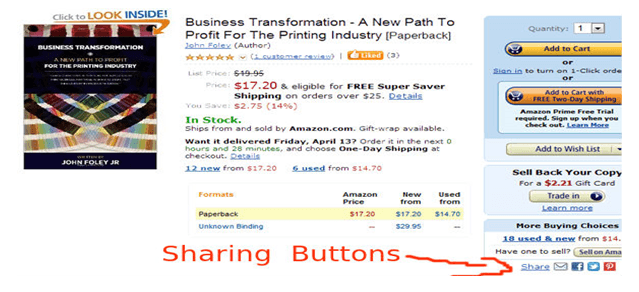
Second most important point is to have social sharing buttons on perfect places. As we all know that all the eCommerce websites are providing sharing buttons on their website, and it is not a new point to know. But the new point to know is to have those buttons on perfect and unique places so that your customers find it easy to share with their Facebook friends and Twitter followers.
amazon sharing buttons
You can place social sharing buttons on your purchase configuration pages or at check-out process so that they can easily share it with their friends and dear ones. When they complete their check-out process, you can give them an opportunity to share what they have purchased after all people love to share their things especially with their friends.
Strategy 3 – Go for Pinterest
go for pinterest
Third important point is, go for Pinterest, which is one of the rapid growing social media websites. This website allows you to share your favorite pictures from across the web with different people. By creating a Pinterest profile for your eCommerce website, you can connect with compatible and new consumers who have much interest of enjoying pictures of different products.

You can easily share pictures of your best products on Pinterest and interact with new customers who may have interest of purchasing your products. But you need to make sure to be unique as other pictures so that it becomes easily possible for you to grab the attention of visitors.

Strategy 4 – Add Product Videos
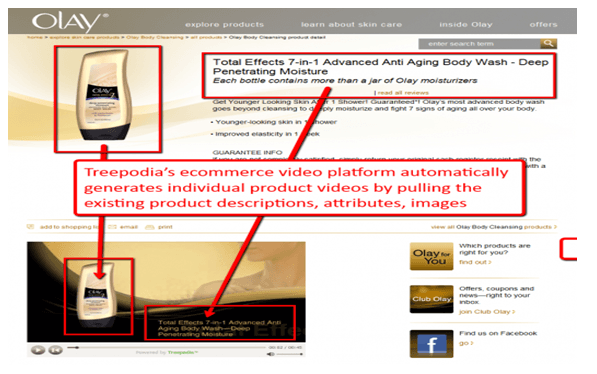
Fourth most important point to consider is adding product videos as videos are considered one of the best sales tools that surely help you to sell your products. We all know that all the people love to see videos especially of those products that they are buying, so it will be beneficial for you and your website to place product videos. On the web, you can find many popular eCommerce websites that provide product videos on their website, and these companies have seen big impact in sales after adding product videos.
olay
Along with adding product videos on your site, it is also advantageous for you to add videos on YouTube, which is one of the biggest video sharing websites on the web. YouTube is one such video sharing website that gives you an opportunity to present your company in a highly effective manner, so don’t forget to add product videos on YouTube.
Strategy 5 – Interact with your customers
Fifth major point is, interact with your customers. Creating a Facebook and Twitter fan page is not enough for you as you need to interact with your customers and have to solve their queries regarding your products. By answering their all queries, you can build strong and long-lasting relationship with your customers, and it will compile them to come back on your website and purchase your products.
Strategy 6 – Offer Some Discount & Product Deals through Social Media Websites
Sixth major point to keep in mind is, offer your customers some amount of discount and product deals through social media websites. By offering discount and offers, you can easily attract them on your website, but you need to make sure that you offer unique offers and deals that they won’t get anywhere else.
50 percent off
 Offer them different contests and sweepstakes through social sites or you can offer them free shipping service, which they surely love. Apart from this, you can provide your customer updated news about your products and services through social channels and lure them towards your website.

Wednesday, February 27, 2013

5 Social Media Marketing Strategies for eCommerce Websites in the Year Ahead


Social media has revolutionized the way we use the internet, and how we consume information. Consumers are no longer the silent majority, and media companies are no longer the gatekeepers of information.
Small businesses can now engage in back-and-forth communication with consumers without traditional media as an intermediary, and this gives the modern eCommerce site an opportunity it’s never had before. Here’s how you can take your eCommerce site to the next level.

Strategy #1 – Understand Why People Use Social Media

A recent study suggests that people use social media to:
  • Communicate
  • Express themselves
  • Pass the time
  • Entertain themselves
These are roughly the same reasons that people use the internet in general, except that people do not use social networks for a fifth and very important purpose: information seeking. This is important, because it also means that people are not using social networks to find information about companies, products, or services.
The study concluded that the main reasons people use social networks are to pass the time and to entertain themselves. For this reason, companies should focus most of their social media efforts on using entertainment to build customer retention and acquisition.
Companies can also leverage those who use social media to communicate or express themselves by building an online community to keep conversations going.

Strategy #2 – Build Relationships With Influencers

Since most people use social networks to entertain themselves and a smaller number of people use them to express themselves, it is often these expressive people who are the most influential people online. Many of them also have blogs or personal websites that they further use as an outlet for their expression.
It is these people who you should focus most of your efforts building relationships with. Since it is rather strange for an eCommerce site to try to build a relationship with an influencer, it’s often a better idea to use personal profiles to do the connecting. On Twitter, it’s better to create several individual profiles that link back to the brand account, and use those individual profiles to build relationships.
There is also no reason to confine the discussion to social media. Many influencers have email addresses listed on their blogs so that you can contact them directly. As long as you start the discussion off by offering value (not asking them for something), this is often much easier than you may think.
Once you have built relationships with influencers, getting attention on social networks is relatively easy.

Strategy #3 – Be Shareable

It is unlikely that very many people will voluntarily share product pages on your eCommerce site. They are much more likely to share fun and interesting blog posts, videos, and images. This should reinforce the idea that social media should not be thought of as a sales channel. It is far more useful as a “first touch” channel and as a customer retention channel.
Since it is rare that a social encounter with your brand will coincide with a need for your product, your primary focus should be on brand image: building trust and familiarity so that you are first on the consumer’s mind when the need does arise.
What is shareable?
  • Novel information that is interesting, surprising, and unique
  • Anything that makes people laugh
  • Anything cute or that gives people “warm and fuzzy” feelings
  • Beautiful images (these do especially well on Pinterest)
  • Posts that reinforce a worldview (sometimes this means taking a side)
  • Content that comes in bite size chunks that are easy to absorb

Strategy #4 – Go Where the Community is

All too often, businesses get caught up in social media as a place, instead of social media as anidea. The savvy marketer realizes that Facebook is not necessarily the place to focus all of their efforts, even though it is the largest social network. In the post-television world, marketers need to move past thinking about volume, and consider targeting instead.
The first question online marketers should be asking is where their community is. No matter what industry you are in, there is a place online where a conversation is happening about that subject. Your first job is to find that community. It could be a Facebook discussion group, but it could just as easily be a forum or message board. That may sound old fashioned, but if it is where your target audience is, it’s where you should be.
That’s not to say you should neglect a more general audience. A strong online community consists of a hardcore following that often exists in a more obscure place, like a forum, followed by a mainstream audience on a place like Facebook or Twitter.
Your primary goal as an online community builder should be to figure out how to leverage these communities in order to build a hardcore following of your own, which then spills over into the mainstream outlets. This means interlinking all of your various online presences and transforming your main site into a home base for all of them.
Remember, social media is not a place. It is a revolution in the way that online discourse takes place. The most important thing to understand about social media is that it allows two-way communication. If you are making conversations happen, you are succeeding, no matter where that conversation is happening.

Strategy #5 – Understand Conversions Directly From Social Media Rarely Happen

Consumers don’t use social media to interact with you. They use it to entertain themselves and interact with their friends. You don’t want to use social media as your primary means of communication with consumers.
Let me say that again. You don’t want to use social media as your primary communication tool with consumers.
Social media is for casual contact. Social networks are noisy and consumers never see every message sent their way. Networks like Facebook actually filter results based on who and what users interact with the most, and so brands rarely show up prominently in their streams.
The advantage of social media is its ability for certain messages to spread virally. People pay more attention to something that has been shared by their friends than they do to an advertisement. Leverage this fact to build new followers, but transition that following over toemail. People don’t necessarily read all their email, but most of them at least see every message in their inbox. This isn’t true for social media.
Again: the advantage of social media is the fact that your followers will share messages with their friends. But ultimately, you want those followers to subscribe to your newsletter, go directly to your site, and see you in channels other than social networks.

Thursday, September 27, 2012

3 Cutting Edge Social Media Sites That Are Changing E-Commerce


Consider the ways in which we spend our time online: social networking, searching, perusing content, emailing, indulging in multi-media, and online shopping.
3 cutting edge social media sites that are changing ecommerce
In theory, the more needs a site can cater to – while still being focused and navigable – the more time a user will spend on the site.
It’s no surprise, then, that the best social shopping sites on the market broach a number of our online activities, and eliminate our needs for other sites in the process. The goal is to satisfy the most needs with the least amount of effort by the user.

How do you do that?

  • Simplify – a picture is worth 1000 words, especially when you’re targeting female customers. A picture also occupies much less real estate than 1000 words on a page.

  • Streamline –  if a user sees a product they like, they likely want to A) share it with friends, and/or B) buy it. Platforms that allow online consumers to see and share images of products they like are the fastest growing aspect of ecommerce.
The following three sites take this one step further, allowing users to purchase products in the same place where they see and share them.

1. Fancy

Description – “The Minimalist Niche”

Fancy allows users to browse feeds of product and editorial imagery aggregated from other sites via a “Fancy It” bookmark button. Once on site, users can follow friends, create lists, and shop for items spanning myriad categories. The site is constantly fresh with beautiful imagery of new, unique products, all the while being fun to engage with.

Fancy
The more you items you “fancy” on the site, the better your recommendations become. Each week, you’ll receive “The Fancy Five” in your email inbox, containing “wonderful things picked just for you.

The Bottom Line: Fancy is a beautiful site of beautifully photographed products that would rarely otherwise be found without exhausting hours perusing niche blogs and sites on the regular.

2. Lyst

Description – “Smart, Organized, Specific”
At first glance, Lyst resembles a more traditional fashion-oriented e-commerce site, with top navigation including links to What’s New, Men, Women, and Designers. The catch is the site’s has a social angle that helps you discover the best fashion for you, based on your preferences. Lyst’s stylefeed keeps you up to date with the latest and greatest from your favorite designers, boutiques, bloggers, and stylists, all of whom you can elect to follow on the site.

Lyst
The end result is a one-stop-shop where you can search, shop, “influence and be influenced,” all in one place. You can even subscribe to instant sales alerts on products saved to your lyst. Just to be sure you really don’t need to leave the site, Lyst also allows you to link your Pinterest account.

The Bottom Line: For the shoppers who love the organization of department store caliber e-commerce stores, but lack the inspiration or direction to navigate wide product assortments on their own, Lyst is dreamlike.

 3. Pose

Description -”The Social Mobile App and Online Shopping Marriage”
Pose is a mobile app similar to Instagram’s user-uploaded photo feeds with comment threads, but it enabled users to attach brand names to items pictured. As opposed to seeing something you like and simply admiring or wondering.

Pose

Pose’s functionality gives you enough information to go the item yourself. Just this week, though, Pose removed that big search step, bringing their platform online and extending it to include shopping functionality straight from the tagged products in users’ photo feeds. Pose’s new online shopping layout is also tried-and-true: nearly identical to that of Pinterest.
The Bottom Line: If you ever desired to buy something you saw on Instagram or Pinterest, look no further.


Friday, April 20, 2012

Mobile Email-Marketing Tips

There are many mobile devices that consumers can choose from: basic feature phones, smartphones, tablets, e-readers and more. Consumers have their own preferences as to what combination of devices to use and whether to use them on cellular connections, Wi-Fi networks, or both. For ecommerce merchants that cater to these consumers, there's seemingly an endless combination of devices and potential connectivity arrangements, all of which affect consumers' overall ecommerce shopping experiences, including how they receive and respond to emails.

Here are four basic tips to help ecommerce merchants better understand mobile email marketing. As you will see, consumer behavior on mobile devices has, in a way, simplified email messaging.

1. Your 'From:' Line Is More Important Than Ever

Many ecommerce merchants don’t think much about their "From:" lines. They agonize over the subject lines as being the most important element. However, when viewing on a mobile device, it is the "From:" line that gets the most attention. Making sure the From line is a basic representation of your company — and that your recipient will recognize it — is vital to your message getting read or simply being scrolled by. Never repeat what is in the From line again in the subject line. Many ecommerce merchants do this and it is a waste of precious subject-line characters. The recipient knows the email is from you; there's no need to repeat it.
In this mobile screenshot of emails, the "From:" names are much more prominent than the subject lines.


Also, consider different From lines for different types of messaging. For example, if you have transactional emails related to an actual order the customer placed, the From line should reflect that to differentiate it from normal promotional messages that the recipients may be receiving from you. In addition, using a recipient’s name as the From line always helps to increase the open rate and the ultimate response rate.

2. Design For Mobile

A few years ago, using beautiful images with Adobe Flash was popular for websites and email. Many large retailers wanted graphically appealing websites. However, in reality heavy graphics are not functional for consumers who want to just fill their shopping carts and check out. In terms of converting visitors, having a functional website that conveys information and is easy to use is the most important goal.
In short, web and email design is trending back to the original basics. This includes a balance of images-to-text and ensuring the most important messaging in the email is still visible with images turned off. In fact, when viewing on a mobile device, most email recipients will display only text-based elements, preferring the avoid the extra steps of downloading graphics.

3. Make the Email Appealing

More consumers are using their mobile devices to preview emails and delete those that are not valuable to them. They may then look at the remaining emails later, perhaps on their desktop computers. What does this mean? Bringing value to a consumer is more important than ever. Great offers, good products or a call to action that is time sensitive are all effective content strategies that will increase the chances your email makes it past the first-round cuts.
This also impacts your frequency strategy. Depending on how often your recipients are previewing their emails on their devices, you don’t want a large grouping of emails from you with no differentiator between them. Emails that look the same will likely get deleted.

4. Get Realistic about Measurement

Many ecommerce professionals have seen a decline in the overall open rate of some of their email programs. Remember, an "open" only registers with an image load. Therefore, with more people previewing on mobile, the likelihood of the images actually being loaded decreases. The reality is many more people have actually viewed that email than is actually stated on an open report.
So how do you judge success? As open rates have declined, conversion rates have conversely increased. This means the recipients that are opening and clicking are truly interested in your product and service and, oftentimes, follow through with an ultimate conversion. Open and click rates, therefore, are becoming less important in the overall measurement of the success of an email campaign as the use of mobile becomes more widespread.

Summary

With the increasing complexity of mobile devices and mobile connections, ecommerce merchants need to understand how consumers view and interact with their emails. This will ultimately dictate how to develop email creative content, messaging and frequency.