Showing posts with label Social commerce. Show all posts

Wednesday, October 8, 2014

4 Reasons Why Email Marketing for eCommerce is Not a Thing of the Past


4 Reasons Why Email Marketing for eCommerce is Not a Thing of the Past
If you’re running an eCommerce store, or any other type of online business you probably have an email list. You might send out emails every now and then, make announcements, send messages to customers, but do you really utilize email marketing to its fullest potential?
I mean, with all the latest marketing crazes – SEO, social media marketing, content marketing – who even has time for something as old as email? (Fun fact: the first email was sent 40 years ago!)
Well, email might be old, but it definitely is not outdated! Email marketing boasts a high click through rate, conversion rate, and ROI, and though it is behind organic search in terms of conversions, as SEO becomes more and more competitive, email marketing provides an excellent alternative.
In this post we’ll explore a few reasons why all eCommerce stores should be using email marketing!

The Preferred Method of Communication

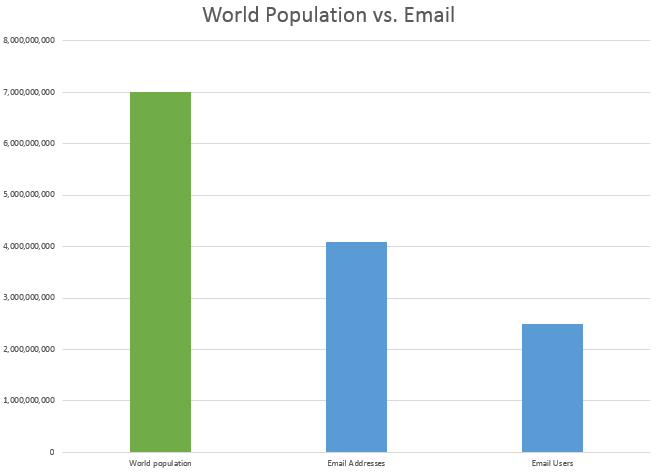
As of today there are over 2.5 billion email users in the world using a whopping 4.1 billion email accounts!
Just to put that into perspective let’s compare that with the World’s population:
Comparison world population vs email users
That’s right, there are more than half as many email addresses as there are people in the World! Now anything that can be compared to the World’s population and not look miniscule is pretty significant, but that’s just crazy.
Now to give this information a little eCommerce spin – 91% of consumers use email at least once a day, and U.S. consumers on average interact with 11 brands via email per day (Captera)! That means that your target customer is almost certainly actively using their email and actively engaging with brands already.
Ok, but people don’t actually like to get marketing information to their inbox, right?
Wrong! Email is actually the preferred medium for marketing information!  According to a study conducted by Exact Target, 77% of people prefer to receive opt-in marketing information via email. This number absolutely crushes the second place choice, direct mail, which received a meager 9%.
Quite clearly email is a fantastic place to be marketing, because so many people use it and so many people like to be marketed to on it.
The next question though is why do people like it so much for marketing?

The King of Customization

There’s more than just convenience and familiarity behind consumer’s appreciation of email marketing – they love it because it can be customized just for them!
How so? Well, just about every email platform that you would use for your business comes standard with list segmentation and analytics features. By using these features you can send targeted and relevant emails to the people on your mailing list.

Segmentation Example

Let’s say you sell sports gear and you want to send out an email promoting men’s (American) football pads, you can go through your segmented lists in order to pick out the right targeting options. In this case you may want to send your email to men living in the U.S. between the ages of 14 and 30.
Another thing you could do is to send this email out with even more specific locations and then mention the local football team for each specific location – so people living in Philadelphia would get an email about the Eagles, people in New York would get an email about the Giants and the Jets, and so on.
You can see how by using segmentation your emails can be far more personalized, and would certainly be appreciated much more by your customers.

Analytics Example

To take the segmentation example to the next level you can dive into the analytics. By doing this you can see what types of content your customers have interacted with most, or what products they seem to prefer.
You can then create lists based on this information in order to send even more highly targeted emails.
Clearly people who received highly personalized emails would prefer over less relevant advertisements.
Need a little proof? Take a look at these stats from a study done by MailChimp comparing emails sent from segmented lists with general ones:
Segmented vs non segmented email stats
The targeting and personalization abilities that email provides for you really make it a very powerful tool. And hey, if the people receiving your emails are happy, then you will definitely be happy too.

The Perfect Partner to Content Marketing

Content marketing is one of the hot topics in the wide world of marketing these days. Everyone wants in. It provides tremendous opportunities for companies to gain exposure organically and through social media while also helping to establish brands as “authorities in their field.” (Check out this post for more on Content Marketing for eCommerce).
All of this contributes to a brands potential for direct and indirect sales. After all, organic search still accounts for the lion’s share of all online sales.
The problem is that gaining organic recognition is becoming increasingly difficult as more and more businesses compete for the same space. On top of that, even if your SEO strategies are top notch, and you’re sure you will be ranked well (because you found the secret to success by breaking into the Google vault…) it will still take a while for your content to actually rank.
This is where your mailing list can really help you out. By building an opt-in mailing list for your blog you are essentially building a guarantee that your content will in fact be seen, because the people that sign up for your list, actually do want to read your content.
This can give you a huge boost!
Click through rates (CTR) from email is 3% for eCommerce stores (and varies for other industries). That means if you send out an email to 1000 people, 30 people will be clicking through to your content, reading it, and potentially sharing it with their friends on social networks, giving your content an added boost.
Are you ready for those numbers to be blown out of the water?
According to a study which tested the difference in CTR for emails that included social share buttons vs. those that didn’t, CTR increases by 158% when share buttons are included! That brings your CTR up from 3% to 7.74%, meaning around 77 people will now see your content!
By utilizing email for your content marketing and combining it with your social networks you can really give your content a boost.

The Most Bang for your Buck

After everything that we have discussed so far, it should come as no surprise that the ROI on email marketing, both in terms of customer acquisition and in terms of sales, is excellent!
Lead Generation: Email is second only to organic search in customer acquisition, accounting for about 7%.
Sales: Email has an impressive ROI of around $44.25 for every $1 spent! 
Needless to say, your money can go very far with email.

What Should You Do?

You may be finishing this article now and thinking to yourself, if email is so great, why have I been wasting all this time on social media? So let me stop you there and say – don’t think that!
Social media is an amazing tool that can help you grow your business in countless ways. It enables you to actively interact with your customers on a personal level, which helps with brand trust, customer support, and brand awareness. It is also very important to maintain multiple marketing channels.
That being said, you should definitely take time out of your schedule to build your email list and to plan out your email marketing strategy.

Tuesday, February 11, 2014

Twitter, Facebook, Pinterest Buttons Rated Most Effective Social Media Marketing Tactic [STUDY]

Twitter, Facebook, Pinterest Buttons Rated Most Effective Social Media Marketing Tactic [STUDY]

Eight in ten digital markets say that social sharing – adding Twitter, Facebook, Pinterest and other social networking icons to their product pages – is somewhat or very effective for increasing conversions from consumers, reports eMarketer, citing data from Adobe.
37 percent of marketers rated social sharing buttons as very effective, with a further 46 percent claiming they were somewhat effective. Live chat/instant messaging, user-created collections and user-generated content also rated highly in the survey.
Twitter, Facebook, Pinterest Buttons Rated Most Effective Social Media Marketing Tactic [STUDY]
Conversely, brand social media is deemed less effective than retailer social media by consumers, with both finishing behind deal and product review sites for purchase influence, reports Ryan Partnership.
Twitter, Facebook, Pinterest Buttons Rated Most Effective Social Media Marketing Tactic [STUDY]

Saturday, November 9, 2013

Social eCommerce and the Customer Network

Image
Last year, consumers and brands alike witnessed the global e-commerce market surpass $1 trillion. In that same year, revenue generated by social networks had reached over $16.9 billion. By 2015, total revenue from social commerce sales is predicted to reach $30 billion. And while the present share of total e-commerce sales is modest, the value of such tactics should not be confined to transactions initiated through social networks alone.

As an industry veteran, I've witnessed firsthand the direct impact of e-commerce innovations and social media technology on business. From sales, marketing, and logistics for global companies, emerging entrepreneurs, and everyday consumers alike; the e-commerce game is certainly changing.
Rather than obstacles in the path of business growth, such innovations serve as a means to broaden brand exposure and expand commercial reach. For instance, targeting products and reaching consumers based on social media connections can humanize the often robotic presence of personalized offerings and retargeted ads. However, excessive intrusion and pushy messaging can alienate the potential buyer or existing customer.

Monday, May 13, 2013

Is social commerce worth the investment?

English: Wordle Cloud Definition of Social Com...

There’s a useful post over at of cloud-based commerce company Venda, that asks a simple, but very pertinent question, is social commerce worth the investment?
The short answer – according to the post – is a qualified yes, if retailers adopt the right approach and tone.
For the e-consultancy post, social commerce is not about turning social media into a marketplace, but using social media to promote the marketplace/site you’re selling on – essentially through social sharing.  Use e-commerce software to sell, and social software to share. Simple, right?
But is that it? Is social commerce really just regular e-commerce with social sharing added in?  Well it’s certainly part of it.  

Wednesday, December 5, 2012

The Social Media Marketing Honeymoon Is Over


Social media marketing has failed business. Pic by jcoterhals
Social media, social media marketing, and social networking have been the subject of much hype, buzz and marketing budget disruption for big and small business alike.
Most businesses entered into social media marketing as a defensive strategy because they were afraid of losing out to competitors who were quicker to adapt and leverage this new platform.
Buoyed up by a seemingly endless cavalcade of social marketing experts demonstrating how their own social marketing success was evidence of how social media marketing would work for each and every business, if only they invested cash, time and effort.
Businesses bought into social marketing wholesale. Huge marketing budgets were allocated for social marketing campaigns intended to catapult the marketing reach and social influence of that business into huge, untapped online markets.

Business and social media marketing today

Business has now invested several solid years in social marketing. It's been a wild ride. Stories abound of incredible marketing successes, dismal social media failures, and everything in between.
But what is the bottom line?

Social media's shocking ROI for Black Friday

According to research by Forrester:
"Social tactics are not meaningful sales drivers"
They arrived at this conclusion after analyzing the primary sales drivers for eCommerce and found that less than 1% was driven by social media.
But this was prior to Black Friday and Cyber Monday of 2012. Surely, several years of investment into social media marketing would have paid dividends on over the biggest online shopping frenzy of the year?
According to IBM Smarter Commerce, which tracks sales for 500 of the top retail sites, social media made up less than 1% of Black Friday sales.
FaceBook, LinkedIn and YouTube combined contributed a dismal 0.34% to Black Friday sales.
Twitter, contributed 0%.

But social media has value, right?

Many proponents of social media marketing will point out that social media has less tangible benefits. It's quite reasonable to assume that someone who sees your brand on FaceBook may not necessarily buy there and then, but may make a purchase further down the line.
Yes, of course, this is absolutely true. There's no debate about whether or not it's productive to have people talking about your company, brand or product on the social networks. Generating buzz, and building social influence do have value.
But let's go back to the bottom line. Consider what your business has invested into all things social in the last few years. In tangible benefits, social media marketing has contributed less than 1% of your revenue.

Working out social media's value

So, has this provided you with a positive ROI? If the answer is yes, then there is no further debate and you can continue happily with your social media marketing strategies and campaigns.
If the answer is no, then you need to consider the value of the intangible benefits of social media marketing.
Let's be generous. Let's assume that the intangible benefits of social media marketing offer an entireorder of magnitude more revenue than the direct revenue. This would mean that social media brings in slightly under 10% of your online revenue.
Compare this to how much you have invested in social media. Do you like what you see?

Why business has gotten social media wrong

Social media marketing has been driven by businesses' fear of losing competitiveness. This is not the same as adopting a new marketing platform because it has proven itself time and again.
The one thing that social media has actually marketed very well is itself! This is because social media has a vested interest in social media.
But why doesn't it work for business?
  1. Buying "likes" was never a smart idea
  2. Likes don't have much intrinsic value
  3. Being great in social media doesn't trump good products and service
  4. Publishing great content requires the skills and expertise of a publisher
  5. People immediately assume there's bias in content that comes direct from a company 

How to use social media marketing properly

Businesses' underlying error in judgement is this:
Business mistakenly views social media as the connection with customers. It's not. Social media is atool to connect with customers.
In other words, that connection with customers that will make them ready to buy is not sufficiently met by social media. Social media is a great tool for reaching out to customers, but it's not the whole equation.
That's why so many businesses are able to obtain fine looking social media marketing metrics (i.e. plenty of likes, lots of "engagement"), but completely fail to convert it to revenue.
Here's what you do to fix the problem:
  1. Start treating social media like a tool that reaches out to customers
  2. Stop believing it can magically conjure sales, if only you get it right
  3. Realign your expectations to meet reality
  4. Create a strategy to build on the achievements of your social media marketing
  5. Be creative and innovative in how you look to further increase trust and engagement online
In other words, start looking at social media marketing as a link in the chain, instead of the whole chain itself.
How you take your engagement with potential customers that have been reached via social media marketing is up to you. It depends on the type of business you are, the type of products and services you offer, and a whole host of other things.
If you can't think of ways to do it, pay someone who can. The great thing about this type of problem, being directly tied to revenue, is that you can offer an expert an incentivized pay structure, so that you only fork out the big bucks if the strategies they put in place generate big bucks.

Monday, December 3, 2012

Avoiding an Online Shopping Social Media Crisis [Infographic]


Image
The winter holidays should be a boon for online retailers.  Thanksgiving and Christmas bring hordes of online shoppers onto the internet, and with the right strategy they could be persuaded to spend time on our sites.  With the wrong strategy you could have a social media crisis on your hands.

If you’re reading this then you managed to survive the shopping holidays of Black Friday and Cyber Monday.  Congratulations!  The period following Thanksgiving has become an enormous marketing event that’s continuing to increase in size each year, and not everyone emerges unscathed.

When it goes wrong
American department store Sears has been singled out for particular criticism for the way they conducted their Black Friday campaign.  A miscoded online countdown clock, order cancellations, uninformed store staff, and a Facebook Page unprepared for a surge of complaints conspired to give shoppers a poor experience at one of the company’s most important times of the year.
At every step of the story it’s clear that there were good intentions and the potential for a successful campaign.  A working countdown clock would have built excitement.  The promise of great deals for the store’s VIP members would have made membership valuable, had the company been able to deliver.  Even the much-ridiculed social media response isn’t entirely without merit.
Sears' Black Friday social media crisis
The brand’s effort to reply to everyone is admirable, but sending the same message to every customer, ‘Romper Room’ style, is impersonal and looks bad on the Page.

How could this have been avoided?
The event demonstrates how easily a good idea can become a social media crisis without a well organised approach.  A strategy encompassing Sears’ employees and representatives in each stage of the process, keeping everyone on the same page, could have made the campaign as successful as its planners had hoped.
With better communication and oversight of the campaign, mistakes like having a countdown clock count down to a different time in each time zone could have been avoided entirely or spotted and fixed before publication.   Excitement about the most popular deals should have been noticed, allowing social media managers to manage expectations of stock levels.  This information could have been shared with store staff to inform them of demand and enable to them to answer questions from customers intelligently.  High interest in the Black Friday sale should have been anticipated, and extra resources allocated for the social media team to spend time preparing more varied standard responses, or to have more staff online to answer questions personally for the duration of the campaign.
Online shopping forces companies to conduct more of their business publicly and very visibly on their own sites and social network pages.  Ten years ago the world wouldn’t have known if you’d been inundated with phone calls and letters of complaint, but the medium of today’s aggrieved customers is the product review sections on your site, the comments on your Facebook posts, and easily retweetable hashtags.
Black Friday vs Cyber Monday
Black Friday sales figures have increased by 8% in the last two years.  In the same time Cyber Monday sales have increased by 41%!  With so many of these sales being made online, surely more time and money has to be invested in the planning and management of online campaigns to keep up with the increasing number of people doing their holiday shopping online.  Take a look at this infographic to see how online and social shopping are where it’s at:
This infographic was conceptualized and brought to you by myhosting.com.
Maximizing Your Dollars on Cyber Monday
Christmas is terrifyingly close.  If you’re running an online campaign this Christmas, have you established lines of communication between all the departments involved?  Has everyone been fully briefed?  Is someone responsible for oversight and coordination?  It’s never too early to get the plans in place.

Saturday, November 24, 2012

Social Commerce: This Field Needs a Fresh Start


Is Fab.com, the hugely successful design items shop, the only social commerce shop out there?  With 8  millions customers in 26 countries, the e-commerce rising star is not stopping – it’s actually shopping, buying smaller me-too competitors over the world. Social has been good to Fab, but did not help social commerce industry to rise. So far. 
In 2011 & early 2012, it was all about social commerce & even ‘f-commerce’. Why do you need a Web shop, just put it on Facebook, where people are! Shopping, which had always been a social experience, would become social on the Web too. The intuition was right: social inspiration from friends, social proof, re-assurance, are key elements in the purchase decision, especially for considered purchases (as opposed to everyday groceries). The next generation of ecommerce would integrate those dimensions natively in the shopping experience, resulting in a new era of shops & growth. The most notable experiment had been conducted with Levi’s ‘shop with friends’ experience, in which you could login through Facebook to see what friends had liked & bought (the site is now offline). New players proposed to put your online shop on Facebook. Those experiments were failures. Soon social commerce projects were shelved. Today, most e-commerce shops look exactly the same as they were 5 years ago, with sometimes a few social media logos in the footer of their home page.
 Maybe this whole social commerce thing was just a mirage.
Was it ? I don’t agree.  They were a few wrong expectations:
  • Inserting a shop on Facebook was wrong: first, because people don’t go back to pages once they ‘liked’ it, it’s all about the newsfeed. If you need to push links to your shop in the newsfeed, it might as well be to your Website: people don’t trust Facebook for shopping, and if they do it won’t make a difference to send a link within or outside Facebook (apart for Facebook itself, which may serve ads about your competitor while the users are shopping on your page)
  • Thinking that you can personalize the shopping experience through social login was too early: unless you are an Amazon or a top 5 retailer, chances that you don’t shop to the same shops as you friends, & even if they do, they did not necessarily optin to share what they do. Maybe the Facebook ‘Want’ button will change that, but not quite yet.
  • People had a too narrow understanding of social mechanisms: social is not simply about ‘seeing what friends do’. For example, the simple ‘Star reviews & ratings’, which have been there forever, are social elements: it’s the value of people talking about the products or services, it’s the content of the review but it’s as well the fact that others are interested, others are buying.

We are still convinced that social commerce has a bright future, as long as the human being will remain a social specie, and that digital matters (you will agree on those two points). The question is more: what should you expect, and how to conduct a realistic, pragmatic social commerce strategy ?
We propose the following ‘maturity model’ – ie depending on your size and degree of sophistication, a simple step-by-step to follow:
  1. Give basic social visibility on your site. Free widgets of Facebook or Twitter exist. They will help, especially if they go along the ‘like’/’follow’ buttons. If you web real estate is precious & you want more control, use a software to integrate on your site.  The first objective of a site is to convince or sell, the second ? Generate an opt-in.
  2. Be multi-social: Social media can be used for both social proofing & inspiration: ensure that you are where your customers are to provide the type of engagement they like at the place. Twitter is more useful for customer service, Pinterest for inspiration, Youtube for education, Facebook for fun & keeping the brand alive (oversimplifying a bit here, but you get the point).
  3. Create & amplify social currency: ask for tweets (even if you are not on Twitter, use hashtags!), Facebook posts, from your happy customers. Engage with a few and amplify to a lot, by then republishing this on your site at key points (product pages, delivery pages, etc…). By doing this on social media, you’ll have more engagement since people don’t need to login, it will be viral since they friends/followers will see it, and it will be credible as attached to a social profile. The result ? A virtuous circle for your shop, highly valuable content for the flock of passive visitors who are desperate for social cues that you have such an amazing web shop & products/services, and as a result much stronger conversion rate.
  4. Curate & amplify: could part of your site be a magazine, that you partly write partly curated ? Why not. People go for ecommerce site to transact but as well to get inspiration. In your area, you might want to be the ‘place to go’ for great content, be it yours or someone’s else, through curation of social content. You could put e.g. youtube videos about golfing on the golf equipement landing page. Remember: people don’t buy at first visit, but then end up buying if you make them come back for more. They will shop with you, for more goods, and more often. In addition, this will nicely boost your SEO performance.
  5. Create on site-engagement: ask questions, quizzes, make sure you enable people to use a social login with an email behind it to gain a lead you will follow. You could even ‘gamify’ your experience, if you dare…
  6. Personalize: this is the holy grail of social shopping. Only a few shops will get there, but who knows it might be yours ? By using social login you will be able to show what others have seen, bought, or simply want, or even shopping with friends. This is completely emerging but may be big in the future. However, if you don’t start with the basic steps, you may never get to that point.
We are only at the beginning of social commerce. We think that now the ‘peak of inflated expectations’ has passed, we can now focus on creating approaches that deliver the results. More than becoming a nice add-on to a social media plan, those steps might become the main focus of your social media strategy, because it’s about what matters to a Web shop: using social media to drive traffic & conversions.

Sunday, July 22, 2012

Why the Future of Pinterest is Stuff Magazine


Pinterest is a (burst) bubble without a viable business model.  The magazine industry has a dead business model.  But together, the two could combine to create next generation of profitable social commerce.
In a nutshell, Fréd, prolific blogger and author of one of the best presentations to date on social commerce, suggests that the next phase in social commerce is curation via a creative combination of “blogging and boarding” – curated and personalized product selections (powered by a next-generation social recommender system) that combines Pinterest-style boards with editorial content.  Ultimately these may evolve into virtual shop assistants with a ‘meta-basket’ allowing shoppers to add products from different vendors as they browse.
From this perspective, the problem that social commerce solves is that it reduces choice by filtering out the junk and presenting users with a personalised range of options – informed  by the selections and opinions of others.  In other words social commerce makes shoppers smarter by acting as a smart intermediary between vendors and shoppers.
Whilst social shopping apps such as ThisNext, Fantasy Shopper, Fashiolista ou Shopcade may come to mind, what comes to mind for us is Stuff Magazine, the FT’s brilliant How to Spend it app, or even the lowly Consumer Reports/WhichMagazine.
One part Flipboard, one-part Pinterest and one part Stuff magazine is the recipe for the next social commerce success story.

(via)

Saturday, July 21, 2012

Mobile Commerce Booms to 15.1%, Social Commerce Falls to 1.9%


New data from IBM (with accompanying report below) shows mobile commerce in 2012 is booming – now representing 15.1% of all online sales (Q2 2012 – up from 13.2% in Q1).
If e-commerce from mobile devices is shining, the same cannot be said of social commerce (defined for the study as sales from shoppers referred from social networks) – which dropped 20% in Q2 2012 to account for just 1.9% of online sales (down from 2.4%).
Of course, we’re comparing apples and pears here – m-commerce is about the device, social – in this report – is about sites. And social commerce is far more than simply converting e-commerce traffic from social sites.  Indeed social commerce is a game of four quarters
  • e-commerce on social (e.g. pop-up stores in social media such as Burberry, in-app purchases for social apps)
  • social on e-commerce (e.g. social plugins on e-commerce sites – e.g. from social media buttons a la American Apparel, to users reviews)
  • e-commerce in-store (e.g. social features in traditional stores – Facebook-connected fitting rooms such as Diesel Cam)
  • in-store on social (e.g. retail events streamed into social media – e.g. Facebook launch of Ford Fiesta0
In the IBM report, all the four quarters of social commerce are essentially excluded if social commerce is reduced to social e-commerce traffic – so social commerce sales are under-reported.
More essentially, it’s becoming clear that it’s a mistake to think of social as a channel.  Channel thinking is legacy thinking; instead social – and indeed mobile – should be seen as a layer, not a channel or silo, in commerce.  Social commerce is about adding social features to the shopping experience not creating another sales silo.
Nevertheless, it’s clear that mobile commerce is growing bigger and faster than social commerce.  Why?  Well, mobile-enhanced commerce has a clear value proposition that hits one of the core 4C’s of marketing – convenience.
Social, on the other hand has yet to communicate and deliver real value with social.  This is ironic because there is a crystal clear value proposition for social commerce – it makes shoppers smarter.  Social commerce allows people to learn from the experience of others.  Only fools learn only from their own experience.  Social commerce is smart commerce.  That’s the value proposition we need to pursue if we are to crack the code of social commerce.

Read Full Article Here

Saturday, June 30, 2012

“Cash Mobbing”: New Social Commerce Trend


Have you done any “cash mobbing” lately? It sounds criminal, but it’s precisely the opposite.
cash mob is an event where people support a local retailer by gathering en masse to purchase the store’s products.
It’s a lovely social idea; the polar opposite of the the popular Chinese social commerce “Tuangou” trend where customers flash mob a retailer and demand a big discount in return for a bulk purchase.
The concept and term, coined by Oracle engineer Chris Smith from NY, was born out of a realisation that happy customers do not need Groupon-style discounts to support good, solid, local businesses.  Create happy customers, they will be willing to help you out in times of need. Using social media to vote on which local businesses to support and get the word out, Chris has organised cash mobs for a wine store, beer store, a restaurant, a bookstore and a coffee shop.
As you might expect, Amex – the poster child pioneer of social commerce – has jumped on the cash mobbing trend with ”Small Business Saturday” cash mobs in which cardholders are given a $25 credit if they use the card at small retailers on a specific Saturday. Kudos Amex.
We think “cash mobbing” is a great acid test for brands and retailers.  Would your brand users and customers love and value you enough to support you with a cash mob?
And is “cash mobbing” a fleeting fad, or is it a people-powered move to humanise – and socialise – commerce?  And if so – is there a business opportunity here – to emulate and build on Amex’s initiative.
Retail for good. Now there’s a powerful proposition.

(via)

Wednesday, June 13, 2012

The Future of Social Commerce: Not a Revolution, but a Plugin


What did one social plugin company say to another?  You’re mine for $151m.  Bazaarvoice, market leader in social plugins for e-commerce sites has announced it is acquiring PowerReviews, #2 social plugin company for e-commerce sites.
Another riddle. How did one social commerce software company go from niche to mainstream and on track for increasing its customer base 10 fold?  8thBridge started selling social plugins for e-commerce sites rather than trying to reinvent e-commerce.
Selling social plugins for e-commerce (and increasingly in-store retail as well) seems to be the secret to social commerce success.  And not a revolution in sight (or on site).
For those versed in the peculiar area of “qwertynomics“, of how vested interests and structures lock-in incumbent solutions even if better ones exist (like the qwerty keyboard, invented to slow typists down by being as unpractical as possible to avoid mechanical arms colliding), the rise of the social plugin should come as no surprise.
Social plugins are incremental rather than disruptive innovation – and thus don’t come up against the wall of vested interests.  More radical revolutionary e-commerce solutions might possibly be better on paper, and even in practice, but we’ve a lot invested in the past. You’ve spent time money and effort on your existing e-commerce solution – so you need a new one like you need a bullet in your head.
Sure, social plugins for e-commerce are perhaps not as sexy as the revolutionary hutzpah of startups on a mission to radically reinvent e-commerce.  But they work, they deliver increased traffic, conversion and additional order value.  And they are psychologically smart too – they allow shoppers to shop smarter with their social intelligence.  Simple but smart – the future of social commerce may be the social plugin.
As Sir Isaac Newton once said, “If I have seen further, it is by standing on the shoulders of giants” – in the world of social commerce, commerce is the giant upon whose shoulder social must stand. Why?  Because that’s where the money lies.  And after all, it’s all about the money, the rest is just conversation,

Read Full Article Here