Showing posts with label facebook. social media facts. Show all posts

Saturday, April 14, 2012

5 Huge Digital Marketing Trends You Can’t Afford to Ignore


Digital marketing is a discipline in flux. We face an onslaught of shiny new technologies and platforms that promise to “change everything.” Marketers are creating similarly breathless headlines, proclaiming the next revolutionary devices/apps/social networks.
Yet, even smart marketers don’t know what changes the future will bring; but they do need to be aware that their industry is changing every day. For instance, to reach consumers marketers need to be increasingly mobile, engaging, relevant and aware of the contexts in which we currently operate.
I don’t pretend to know the future. But the decisions and products of AppleAmazon and other innovators will affect how we live in the years to come. As we anticipate our connected, Minority Report-style future, here are five big marketing ideas to embrace now to get ahead of the curve.

1. Location Services

Consumers are out there and many want you to find them. Location features of social apps such asFoursquareBan.jo and Path are potential goldmines of important consumer data. The near field communication (NFC) technology in products like Google Wallet is just starting to show its potential. And while privacy issues surrounding location services will need to be resolved, consumers are still demanding that marketers understand all of their daily contexts and find ways to make their lives easier. If the rumors are true and the iPhone 5 has NFC embedded, expect these features to go from leading edge to mainstream.

2. New Ad Formats

While new online video and mobile platforms are — unsurprisingly — attracting a lot of heat, their marketing spend is still way out of whack, compared to the amount of time consumers spend there.
Don’t just throw money at these new channels. Instead of pre-roll video ads and other “forced view” options, look to user-initiated solutions that respect the user’s time and interests. Research new ad formats that help brands look beyond clutter and “banner blindness,” such as in-image ads, which integrate brand messages elegantly within relevant content.

3. User-Generated Curation

User-generated curation (UGC) is powered by content discovery apps such as PulseFlipboardFancy andFoodspotting. Content producers and merchants provide the feeds, and consumers tweak them to suit their interests and contexts, filtering data and curating personalized information platforms.
These models can help brands become relevant to consumers and provide the next great opportunities for marketers. For instance, Pinterest has received applause from consumers and marketers alike, and has demonstrated the power that personal curation and relevance can have for engagement.

4. Advertise by Format

Everyone is excited about mobile’s potential, and tablets present appealing platforms or consumer engagement. If you’ve decided to advertise on mobile apps, what are you going to do with the user after you get him or her to tap? Will you use the platform to its full potential? Or will you roll out the same old display strategy you’ve been using online, praying that users will choose to interact with your ad?
It’s time to get creative and imagine the new possibilities. Media industry guru Ken Doctor points to innovative advertisers who take advantage of the iPad’s unique format. “What’s better for an insurance company like Liberty Mutual than threatening you with disaster (tornado, earthquake, flood) and then, by simply tilting your iPad see the damage magically disappear,” he poses.
5. Integrated Marketing
Being relevant to your customer in every context improves brand recall and enhances engagement. Ditch the silos in your advertising strategy (e.g. this is what consumers watch on TV vs. on their phones) and focus on the most important thing — your customer.
In this increasingly interconnected world, consumers are not necessarily thinking in terms of silos. Researchshows that 72% of consumers want to be engaged with an integrated marketing approach, but only 39% are receiving that. Google found that consumers had 74% brand recall when the advertiser’s integrated strategy carried across mobile, TV and online.
While the world is not yet seamless, QR codes and “bridging” apps like Viggle deliver second screen relevance, and can help marketers unleash multiplatform, integrated relevance.
Today’s profound advancement in tech and media is changing how we interact with and filter our world. Smart marketers can succeed by engaging with the trends that are resonating most with the emerging consumer of today.

Thursday, April 12, 2012

Know the Best Social Media Optimization Techniques

A year or so ago just using social media would have been great – nowadays it is necessary to optimize your content and website when it comes to getting the most out of your social media. There is no debating the importance of social proof and social searches. Search engines such as Google, Yahoo, and Bing are increasingly using social networks such as Google+Twitter, and Facebook when it comes to ranking websites. This is another reason to be aware of some of the best social media optimization techniques.

Make sure your content is easy to share


You want others to see and experience your content; it is essential that you make sharing your content as accessible as possible. If someone has to jump through a thousand hoops before they can share something, chances are that they will not do it. Make sure that you have an easy system in place that allows others to share your content.


Social media are great, but do not forget about your website


Truth is that if your business only has a Facebook account instead of an actual website, it is going to look rather cheap. Do not forget about your website, in fact it needs to be a centralized hub where people can gather to find information about your brand. Incorporate your Facebook content and Twitter feeds into your website, link to your YouTube videos but give end-users a single URL to bookmark.


Do not be afraid of feedback


How many times have we seen it in the last few months? A company representative makes a snide remark on Facebook or Twitter and someone ends up taking a screenshot. We have also seen large companies censor legitimate complaints from their Facebook page. If you want to know exactly how people feel about your company or services, offer them a chance to provide feedback. 


If the message is positive, be sure to respond – you may just have made a lifelong fan. If the comments are critical, a quick response is not only the best way to react but also unexpected. If someone has a complaint and they feel that they are being taken seriously, chances are they are willing to give you another chance. This does not mean that you do not have the right to censor those messages that just seem to be hell-bent on spewing venom onto your page.


Reward inbound links


This does not mean that you have to promise a free flat screen television for anyone who sends someone a link. It means that you have to encourage people to want to come to your website. It does not matter if you have funny Facebook status updates, if you provide hints through Twitter, if you have a YouTube channel that introduces people to your company, as long as you make it appealing for people to want to come back.


Acquire (and display) social proof


Social proof not only encourages people to want to read your content, but it also makes them want to share it with friends and family. Social proof means that people tend to assume that the actions of other people provide us with the correct behavior in a given situation. The reasoning behind this is that others probably possess more information about the situation. This means that as humans, we are programmed to learn from the actions of others. Real life examples would be a velvet rope at a nightclub, an exclusive restaurant that does not allow you to make reservations for weeks, or a movie theatre where people are waiting outside to get in. People passing by want to know what could possibly be worth the wait.


This adds to your online credibility. It is normal for most people to want to learn more about what is already popular. Ask yourself, which link would you click – the one with four Facebook likes or the one with several thousand likes that also comes recommended by at least two of your Facebook friends?


Instant Social Media Connectivity


There are many desktop applications for always on or instant access to social media accounts. Popular ones are TweetDeck, Seesmic or Hootsuite. These applications allow fast access to many social accounts within one application. You can view all your social media accounts under one roof in order to manage or distribute your messages. You would also need fast internet connections to access, download or upload messages and content. AT&T is offering great discounts on their internet services you can easily get an ATT uverse coupon and save on your internet service.


(Via)


Wednesday, April 11, 2012

The Amazing Merits of Social Media


Have you ever noticed that “Like us on Facebook”! stamp on the back of a chips or cookies package and wondered who in the world loves their snack foods so much as to want to get daily updates in their Facebook news feed? Social media has become the marketing Holy Grail. How to sell something successfully to the mass of social media users is the subject of countless how-to books and lecture series, yet few companies have really found much success.
We would argue that while Facebook isn’t the best place for Dove to sing the merits of their newest body lotion, it is unquestionably a great place to connect with friends and family. Most of us can benefit from that connection for more than just finding out how Grandpa did in his golf game. Whether it’s networking to get a new job or scouting out a potential date, this week we’ll explore ways to use social media to sell yourself.
Do you ever wonder how can you benefit from the network you’ve established on Facebook or Twitter? Imagine you have a beloved cat that your three year old suddenly develops a debilitating allergy to. You wouldn’t think of dropping Fluffy at the shelter with a bag of kibble and a “best of luck.” Before social media, you would have been calling everyone in your Rolodex, hoping to find someone willing to adopt your pet that you knew would care for Fluffy. You would likely have spent days or weeks, perhaps resorting to a classified ad if you got desperate. With Facebook or Twitter, you can send one heartfelt message to everyone you know, asking them to re-post to their friends, and so forth, instantly reaching hundreds of potential cat lovers.
Use Social Media To Make Connections:


Are you seeking someone to share your popcorn with at the new Captain America movie? One intriguing invite and you’re likely to have a response before the day is done. If you’re looking for a more long term relationship, consider participating more actively in groups that fit your interests. As you post comments and join conversations, you’ll meet others with similar loves and interests.

Use Social Media To Get A Job:


If you’ve recently joined the ranks of people looking for employment, Facebook and Twitter can be a great way to find out about companies that have openings. If you reach out to your extended group of friends and family using social media, you may discover recently created positions that haven’t yet been advertised. Often a company will be short handed, but not able to actively recruit, and a fellow employee or friend recommending you can go far to get your foot in the door.

Use Social Media To Sell Old Gear:


Finally, if you’ve got a few extra gadgets, or perhaps an elliptical machine gathering dust in your garage, consider the opportunities of using your social media network to hawk some wares. One option is to create a group and invite your friends and family to participate. You can post pictures of what you want to sell, and add a comment with the description and price. Encourage others to post pictures of their own spare items and create an impromptu bazaar. Add tags to photos of products you think certain people in your group would be interested in. If you create an open group, it means anyone can join, while closed means you (or whoever you appoint to administer the group) has to approve people asking to join.  It’s up to you to decide how large of a pool of potential buyers you want to amass. You may never have to wake up at the crack of dawn to host another garage sale.


Tuesday, April 10, 2012

Why Bother Monitoring Social Media?


Even if you or your clients have "decided" not to actively participate in social media,it’s really not a choice. Nature abhors a vacuum, and so does social media. Either you can fill the vacuum with your perspective, or your customers and competitors will fill it for you. The choice is clear.
Monitoring helps with branding and marketing and can help identify quality control or customer care problems that may have gone unnoticed.
Monitoring is only one piece of the puzzle, however. It’s important to find out who is saying what, and where the conversation is happening so you can respond appropriately.

Terminology

There are few terms you’ll need to be familiar with before we talk about the tools, so let’s take a moment to cover them before we jump into the details.

Influence

If you find there are customers who have a strong opinion of your brand, it’s important to understand the influence of those customers.
  • How many followers do they have?
  • Do they get retweets?
  • How many external links point to their blog?
  • How many comments do their blog posts attract?
Several of the free tools listed below include this measurement to assist in your monitoring and response efforts. All of the paid options include it.

Sentiment

Are the comments positive or negative? Most current tools attempt to assign sentiment to a post automatically. While this is helpful for brands with tons of mentions, it’s only about 70% accurate in most cases[1], so manual verification and spot-checking is encouraged across the board before making any decisions based on influence data.

Volume

This is simply the amount of "buzz" that exists. Many monitoring tools give the ability to chart volume for specific keywords over time. This gives you a great way to measure the impact of your marketing efforts and social media campaigns, especially when combined with sentiment. A lot can be learned about your brand and your customers by investigating spikes in social media volumes.

Workflow

Workflow is the process of assigning, tracking and responding to social media, typically in a team environment. An effective workflow can prevent double responses and missed opportunities.

Monday, April 9, 2012

Social Media Facts

Social media is a place to share, so here is a breakdown of 23 high-level numbers and statistics that can make jaws drop, and get the hamsters in their heads turning the wheel.  If you are asking why 23, well I was watching the NBA with my nephew when thinking up this post and figured I would pay homage to Jordan. Feel free to share in presentations as you like.

  • In the US, there are 149M active Facebook users, 70% log in once a day – Ogilvy; BuddyMedia
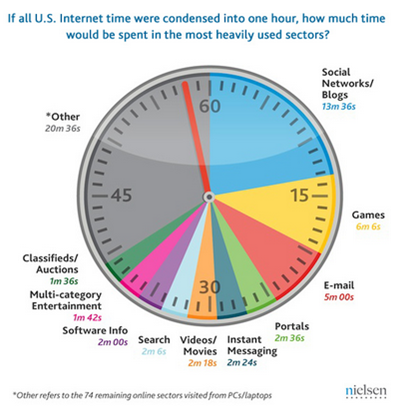
  • Social media accounts for ~ 25% of all time spent online over 35 minutes per hour –Nielsen
  • Facebook accounts for 8.93% of all website visits in the US. All of Google’s properties including YouTube, Gmail, Google accounts for 9.85% – Experian Hitwise
  • 64% of Facebook users have liked a brand on Facebook - ExactTarget
    How much time is spent on social media
  • By 2012, half of the world’s Internet users, 1 billion people, will have a Facebook account – TIME (12/7-1/3 edition)
  • Facebook’s fastest growing demographic is 17-35 year olds – TIME
  • 43% of Facebook users who “unlike” a brand do so because of too much push marketing – Exact Target
  • 46% of Internet users worldwide interact with social media on a daily basis -TNS
  • 25% of social media users are more likely to look into a brand advertising on social media – Adology
  • 15% of these users are more likely to purchase from social media advertisers – Adology
  • 38% of Small  Micro Businesses would use social media more if they had more time or a convenient management solution –  Vistaprint
  • 46% of micro business owners utilize social media – Vistaprint
  • $4.26 billion will be spent on social media marketing globally in 2011 – eMarketer
  • 17% of US online consumers have created a Twitter account – ExactTarget
  • 48% of Twitter users check their account at least once a day – Exact Target
  • 71% of Twitter users expect to receive marketing messages via the platform – Exact Target
  • 41% of users who have unfollowed a brand on Twitter did so because they were over-marketed to – ExactTarget
  • 46% of Twitter users meet with friends more in person over 2009 – Social Mythbusting
  • 78.6% of consumers have joined a company’s community to get more information on the company – Universal McCann
  • 71% of community members say they are more likely to purchase from brand – Universal McCann
  • 66% of company community members note that the community has made them more loyal to a brand – Universal McCann
  • 63% of corporate community members note that they will recommend brand to friends/family – Universal McCann
  • Ford’s 2011 Explorer launch on Facebook generated a 200% greater return than a Super Bowl ad.